


A weekly email on crypto card fee changes, new cards and cashback cuts.
Yield crypto cards: 18 cards where your wallet earns in DeFi
Of the 43 cards whose apps mention yield, re-read against issuer pages, 18 made this list: the app gives you a wallet whose keys you hold (or hybrid custody), and the same app puts money into a DeFi protocol that the issuer or its vault provider names: a lending market, a vault, liquid staking or a yield-bearing stablecoin. Staking the issuer’s own token, points, custodial Earn and anything “coming soon” do not count. Screened October 2, 2026.
Plenty of crypto cards say your money earns. On most of them the company holds the money and pays you a rate. On these 18 the wallet is yours, and the yield comes from a lending market, a vault, liquid staking or a yield-bearing stablecoin that the issuer, or the company running its vault, names, so you can look up where your dollars actually are. They differ on which balance earns. On 7 the card pays from the earning balance itself, and probably on Ethena Pay too. On the rest you move money between a vault and the card, or the card borrows against what you deposited.
The short version
- 7 cards spend straight from the money that earns: Ether.fi Cash, Exa, MetaMask, Tuyo, Plasma One, Deblock and COCA. Ethena Pay probably does too, though its pricing page does not say so.
- 9 keep the yield in a separate vault, and Xplace lends against your deposit instead of spending it.
- 8 of the 18 sit on Morpho, Aave or both. Different apps, often the same lending protocol underneath.
- None of it is a deposit. Rates float. In 2026 an exploit at Drift pushed Fuse users to Kamino, and one at a Rain card contract reached Tria card balances.
Some card buttons below go to affiliate partners, and we may earn a commission if you sign up. The order comes from our public rating formula either way; read our editorial disclosure. 11 of the 18 cards carry a partner or referral link from us: Ether.fi Cash, Bleap, Hyperbeat, Plasma One, Xplace, MetaMask, COCA, Solid, Tria, Tuyo and Ledger.
DeFi yield is not a savings account. There is no deposit insurance, the money sits in smart contracts that can fail, and every rate on this page is variable. Credit modes add liquidation risk when the collateral price falls. This page describes what each app contains, from the issuer’s own documents and our own screenshots. It is not advice to deposit anything.
Three ways a card meets your yield
The question that matters is which balance earns. If the card pays from the earning balance, your money works until it is spent. That is the case on Ether.fi Cash, Exa, MetaMask, Tuyo, Plasma One, Deblock and COCA, and probably on Ethena Pay, whose pricing page will not quite say it. Several of them need one opt-in step first: you put the money into the vault once, and from then on the card draws on it.
On the other 9 the yield sits in a vault next to the card. Money in the vault earns; money on the card does not. Spending saved money means moving it across first, and on Solid the round trip takes two steps. A separate pot has one upside: a bad day in a lending market stays away from the money you buy groceries with.
Xplace does a third thing. Your deposit stays in Kamino and keeps earning, and the card borrows against it. You never sell the asset, and you can be liquidated if its price drops far enough. Ether.fi, Exa, Hyperbeat and Solid also offer a credit mode.
All 18 cards, by our rating
The order is the Sweepbase rating, the same formula the rest of the site uses. It gives every card on this list the same small bonus for having yield and does not score the rate or the protocol behind it, so read the notes, not just the order. The same 18 cards are on one page as a filterable grid in our DeFi cards category.
 1. Ether.fi Cash Card
Sweepbase rating: 4.9 out of 5 · How it earns: Spends from the earning balance · Protocol: ether.fi Liquid vaults · Custody: Self-custody
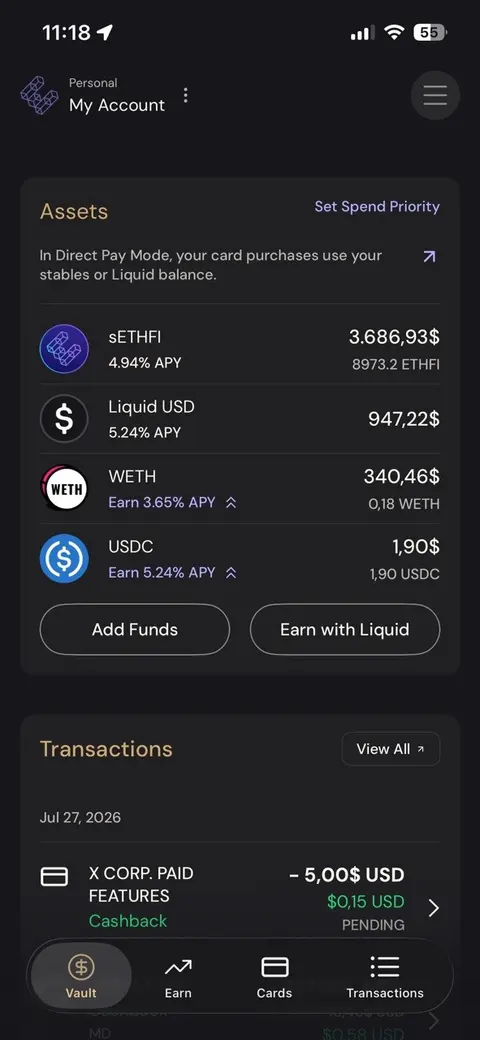
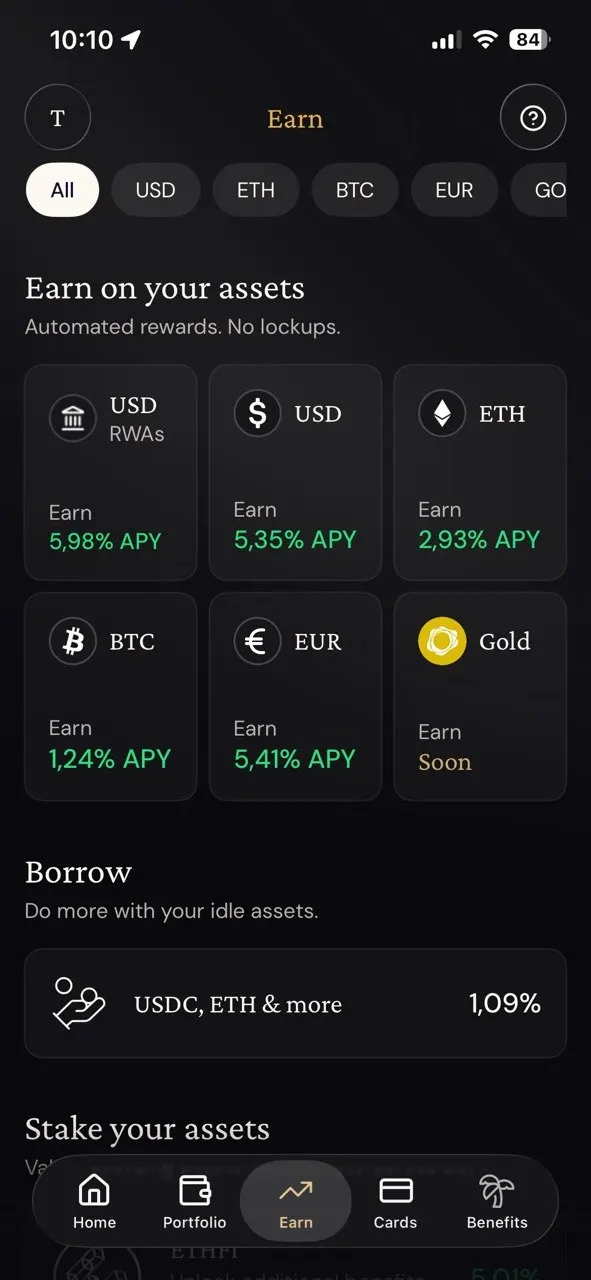
Ether.fi is the plainest case of spending from yield. In Direct Pay mode you rank the assets the card may draw on, and the Liquid vault tokens (liquidUSD, liquidEUR, LiquidRWA and the rest) sit on that list next to plain USDC. A purchase comes out of whatever you ranked first, so a Liquid position earns right up to the purchase. On 27 August 2026 ether.fi showed 5.35% on USD and 5.41% on EUR, variable and not guaranteed.
Cashback is 3% on capped monthly spend (4% on VIP), paid in ETHFI with a seven-day lock. USD and EUR purchases carry no FX markup; other currencies cost about 1% to 1.5% on the base tier. The card reaches most of Europe, though not the Netherlands, Finland or Estonia. Borrow Mode is the part to read twice: it opens a credit line against the same vault collateral at a rate ether.fi does not print, and a Health Factor at or below 1.00 means liquidation.
Open Ether.fi Cash CardPartner link.
 2. Bleap Card
Sweepbase rating: 4.7 out of 5 · How it earns: Earns in a separate vault · Protocol: Lido · Custody: Self-custody
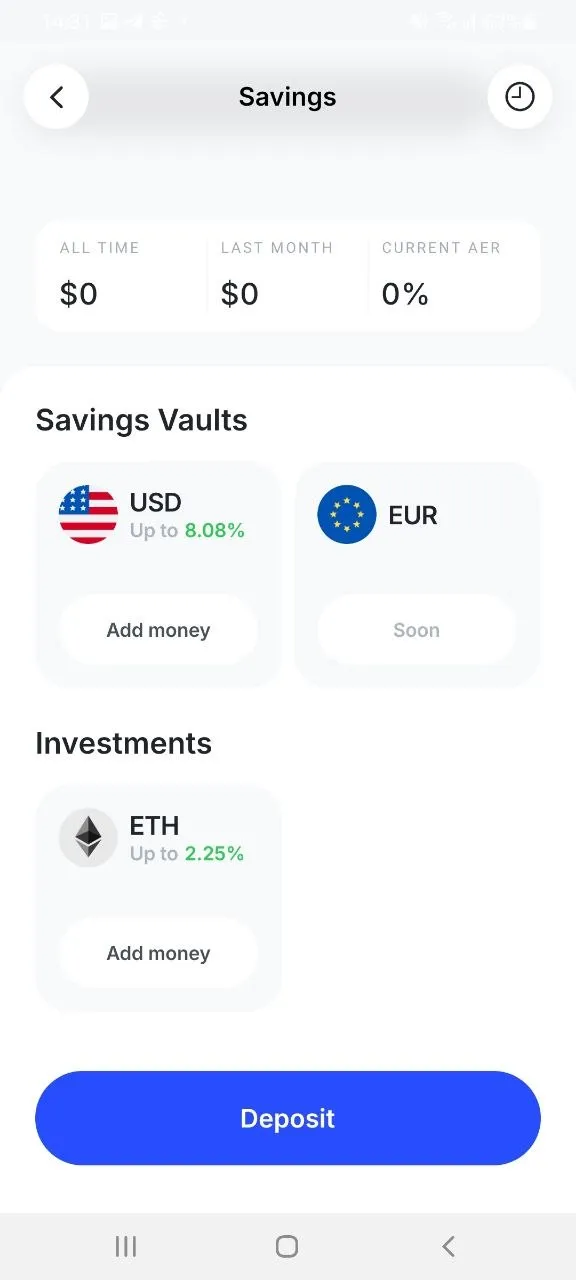
Bleap keeps savings and spending apart, and says so. The card page prints up to 3.83% AER on the USD vault, with no lock-in, and 2.58% on ETH staking through Lido. The app on 3 October 2026 told a different story: the USD vault at up to 8.08%, ETH lower at up to 2.25%, and a euro vault marked Soon. To spend saved money you move it back to the card balance first.
Lido is the only protocol Bleap names on the page itself. Sky and YO Protocol turn up in the savings page code, next to a line that steers users from Angle to Sky “due to recent external changes affecting Angle”. The card is cheap to hold: free to issue, no annual fee, 0% conversion on stablecoin spending. Unlimit EU Ltd issues it in Cyprus, and Bleap writes that it holds neither client assets nor keys. Base cashback is 1%, and the big merchant rates are capped by spend, so 20% on Netflix comes to about four euros a month. EEA and Switzerland, and not yet every EEA country.
Open Bleap CardPartner link.
 3. Hyperbeat Card
Sweepbase rating: 4.6 out of 5 · How it earns: Earns in a separate vault · Protocol: Morpho · Custody: Self-custody
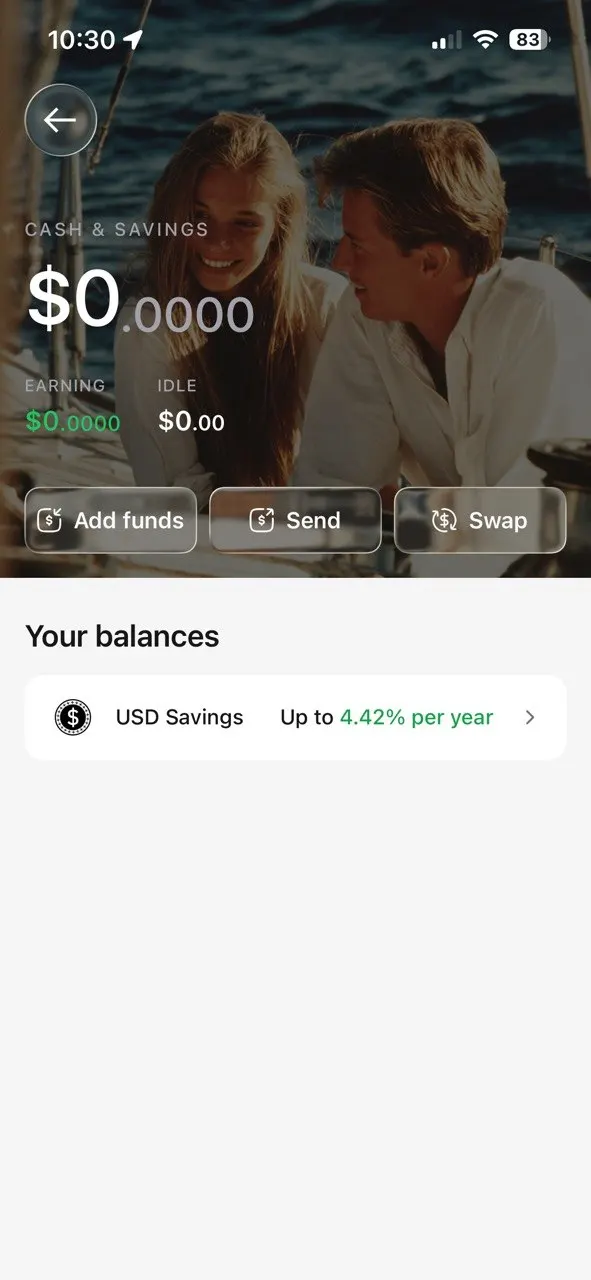
Hyperbeat’s spending balance earns nothing by itself. The yield lives in USD+, a separate vault that lends into Morpho markets on HyperEVM. Hyperbeat publishes three targets for it: 3% to 8% in the help centre, typically 5% to 8% in the docs, up to 8% on the homepage. No realised figure anywhere. The app showed up to 4.42% on 27 August 2026, below the docs’ range and at the low end of the help centre’s.
In Credit Mode, USD+ backs a credit line at 75% LTV, so the card spends against the vault without redeeming it. That is a variable-rate loan with interest from day one, not spending from yield. The card is virtual only, FX costs 0.4% to 1% on top of the Visa rate, and cashback starts at 0.20% and reaches 1% with holdings and spend, paid in WHYPE. A separate ladder pays more on leveraged trading volume.
Get Hyperbeat CardPartner link.
 4. Plasma One Card
Sweepbase rating: 4.6 out of 5 · How it earns: Spends from the earning balance · Protocol: Veda vault lending to Aave · Custody: Self-custody
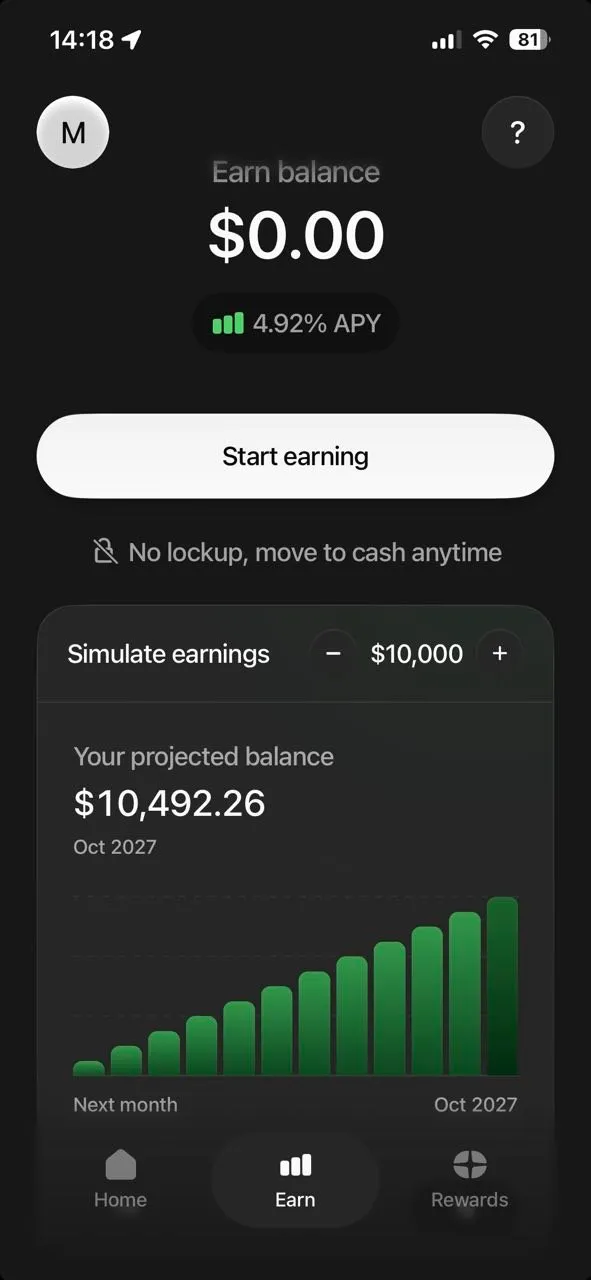
Plasma One pays from its Earn vault once you have put money in. After that one deposit the card spends the earning balance; the Plasma homepage puts it as “Keep earning on your balance until you spend”. Veda, which runs the vault, says it lends to stablecoin markets such as Aave. Plasma itself names no protocol. The site advertises up to 6% APY, variable and tier-based, and the Earn screen showed 4.92% on 3 October 2026, with no lockup.
The free Lite tier is virtual with 1% FX. Core costs $199 a year or a 20,000 XPL lock and cuts FX to 0.5%. Plastic is for Platinum, which needs 100,000 XPL locked, apart from a small Core test. The base cashback ladder reaches 4% and steps down across spend bands (AI merchants pay more), all in XPL, a young token. Rain issues the Visa.
Get Plasma One CardPartner link.
 5. Xplace Card
Sweepbase rating: 4.6 out of 5 · How it earns: Borrows against the earning deposit · Protocol: Kamino · Custody: Self-custody
Xplace is built around borrowing. In Credit Mode your SOL, BTC, ETH, USDT or jitoSOL sits in Kamino, earns, and backs a credit line the card draws on: “Your assets in Kamino earn yield and back your credit line at the same time.” The issuer page showed about 6.15% on SOL, 5.43% on BTC and 3.26% on USDT in July 2026. A price drop can liquidate the collateral, and an unpaid balance accrues interest.
Third-party reviews also describe a Cash Mode that spends stablecoins directly; Xplace’s yield page did not mention it on 3 October 2026. Tiers run from free to $999 a year, with 1% FX on Silver and Gold. Third National issues the Visa Credit. There is no ATM access, and Xplace publishes no country list, only exclusions.
Open Xplace CardPartner link.
 6. MetaMask Card
Sweepbase rating: 4.5 out of 5 · How it earns: Spends from the earning balance · Protocol: Veda vault lending to Aave and Morpho · Custody: Self-custody
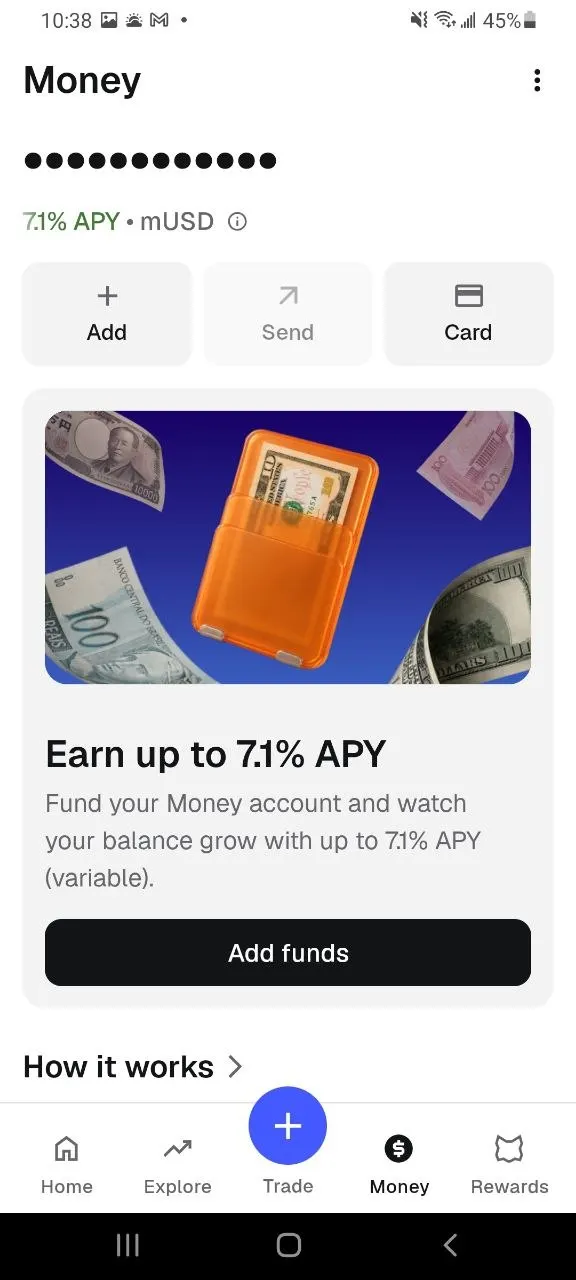
MetaMask’s Money Account holds mUSD in a vault built on Veda that lends to Aave and Morpho, and the card pays from that account automatically. The rate floats. The app showed 7.1% on 27 August 2026, while the published figure was up to 4% plus a 6% promotion whose end date the help centre and the landing page give differently. Plain USDC and USDT that the card can also spend earn nothing, so the money has to be in mUSD.
The card you can get today is the free virtual one, in 47 countries, with the US and UK closed to new sign-ups. It pays 1% back. A 1% cross-border fee applies when the merchant sits outside your country, plus 0.5% when you spend a stablecoin in a currency that is neither yours nor the merchant’s. Metal has taken no orders since 2 June 2026.
Get MetaMask CardPartner link.
 7. Ethena Pay Card
Sweepbase rating: 4.4 out of 5 · How it earns: Unclear: the pricing page calls the card a separate product from the yield · Protocol: USDe · Custody: Self-custody
Ethena Pay pays on USDe held in its wallet: the USDe base rate plus a Daily Boost, to 5% APY on up to $5,000 (Standard) or 6% on up to $100,000 (Pro) and $1,000,000 (VIP), paid daily in USDe. The Boost needs at least one card purchase a month, and the pricing page calls it a promotional incentive, “not interest, not yield, not a deposit”.
Whether a purchase draws on that earning USDe is less clear than it looks. The same pricing page calls the card “a separate product from Ethena Pay’s other services, including the USDe savings and yield features”, and balances that are pledged lose the Boost. The rest of the paperwork is unusually complete: no issuance, annual or FX fees beyond Visa’s own conversion, a virtual Visa from Third National, cashback paid in AVAX, and a beta that opens to new cohorts weekly.
Ethena Pay Card sign-upNot a partner link.
 8. COCA Card
Sweepbase rating: 4.2 out of 5 · How it earns: Spends from the earning balance · Protocol: Morpho · Custody: Hybrid custody
COCA puts the USD balance itself into Morpho, with Gauntlet as risk curator, according to its own 3.0 announcement, and the card spends that same balance: “Your balance stays fully spendable the entire time.” The terms of 1 September 2026 put the rate at 5% APY on USD, and COCA confirmed in writing on 15 September that no tier cap applies. EUR balances earn nothing. Interest accrues in real time but has to be claimed by hand, $1 at a time at least.
Custody is hybrid: the account is a smart-contract wallet you control, and the prepaid Visa authorises against it purchase by purchase. Spending USD stablecoins in dollars or EURC in euros costs nothing; other currency pairs cost 0.5% to 1.5%. Base cashback is 1%, in 76 countries outside the US and Canada. A separate Stake screen offers ETH staking (2.60% on 3 October 2026), with Polygon and Solana listed as coming.

Get COCA CardPartner link.
 9. Deblock Card
Sweepbase rating: 4.2 out of 5 · How it earns: Spends from the earning balance · Protocol: Morpho · Custody: Hybrid custody
Deblock is a French account with an IBAN, and the balance you spend from is the one that earns. Account Yield pays 2% on the free Standard plan and 4% on Premium, at 10 EUR a month. The source is a Morpho vault holding EURCV that lends only against Bitcoin, and Deblock smooths the rate from its own reserve: “Most users don’t want a rate that wobbles, so Deblock smooths it.” Card payments and instant SEPA keep running on the same balance.
One warning the marketing page leaves out: the help centre says that once you opt out of Account Yield, “you won’t be able to opt back in”, while the 4% page answers “Can I opt out?” with “Anytime, in one tap.” Euros sit in a safeguarded e-money account that Deblock runs, while crypto stays in your own wallet, which is why we list custody as hybrid. Euro card payments carry no FX fee; other currencies are free up to 1,000 EUR a month on Standard, then 0.5% on weekdays and 1% at weekends. Any legal resident of the EEA can open one. The UK is out.
Deblock Card sign-upNot a partner link.
 10. Jupiter Card
Sweepbase rating: 4.2 out of 5 · How it earns: Earns in a separate vault · Protocol: Jupiter Lend · Custody: Hybrid custody
Jupiter Mobile puts the wallet, Jupiter Lend and the card in one app. The Earn button deposits SOL and stablecoins into Jupiter Lend, but the card spends a USD balance held by its issuing partners, Rain or DCS, so earning money has to go to Spend first. During the Rain contract exploit of 28 August 2026 the card partner paused card-balance withdrawals for a security check that finished the same day, and Jupiter reported no loss.
The card reaches Latin America, Asia-Pacific, Africa, the Middle East and 31 US states, but not the EEA or UK. Cashback is 2%, capped at $100 a month. FX is 1% on Rain cards and 1.8% on DCS cards, which go to residents of nine Asia-Pacific markets, and nothing on USD.
Open Jupiter CardNot a partner link.
 11. Exa Card
Sweepbase rating: 4.0 out of 5 · How it earns: Spends from the earning balance · Protocol: Exactly Protocol · Custody: Self-custody
Exa sits on its own lending market. Deposits go into Exactly Protocol pools and earn, and in debit mode “the value of every purchase you make will be directly deducted from your balance.” Smart-contract risk applies from the moment you deposit, whichever mode you pick.
The card is a virtual Visa Signature issued through Rain, free to get and to hold, with no cashback and 1.5% on non-USD purchases. It is not offered in the EEA, UK or Canada. Credit mode turns each purchase into a fixed-rate loan against your collateral, split into up to nine monthly payments, and a falling price can liquidate it.
Exa Card sign-upNot a partner link.
 12. Fuse Card
Sweepbase rating: 3.9 out of 5 · How it earns: Earns in a separate vault · Protocol: Kamino · Custody: Self-custody
Fuse Earn is a tab in the wallet where you deposit into Kamino. The support page still lists Drift as well, but Drift froze deposits after the exploit of 1 April 2026 and is relaunching as a perps venue, so Kamino is the one that works. Deposits leave the balance the card spends: a virtual prepaid Visa from Lead Bank that pays USDC from a Solana smart wallet, up to $2,000 a day by default. No cashback, no ATM, roughly 1% at Visa’s rates abroad. The homepage says “over 18 countries” and links to an eligibility page that names two, the US (without New York and Alaska) and Argentina.
Open Fuse CardNot a partner link.
 13. Solid Card
Sweepbase rating: 3.9 out of 5 · How it earns: Earns in a separate vault · Protocol: BoringVaults · Custody: Self-custody
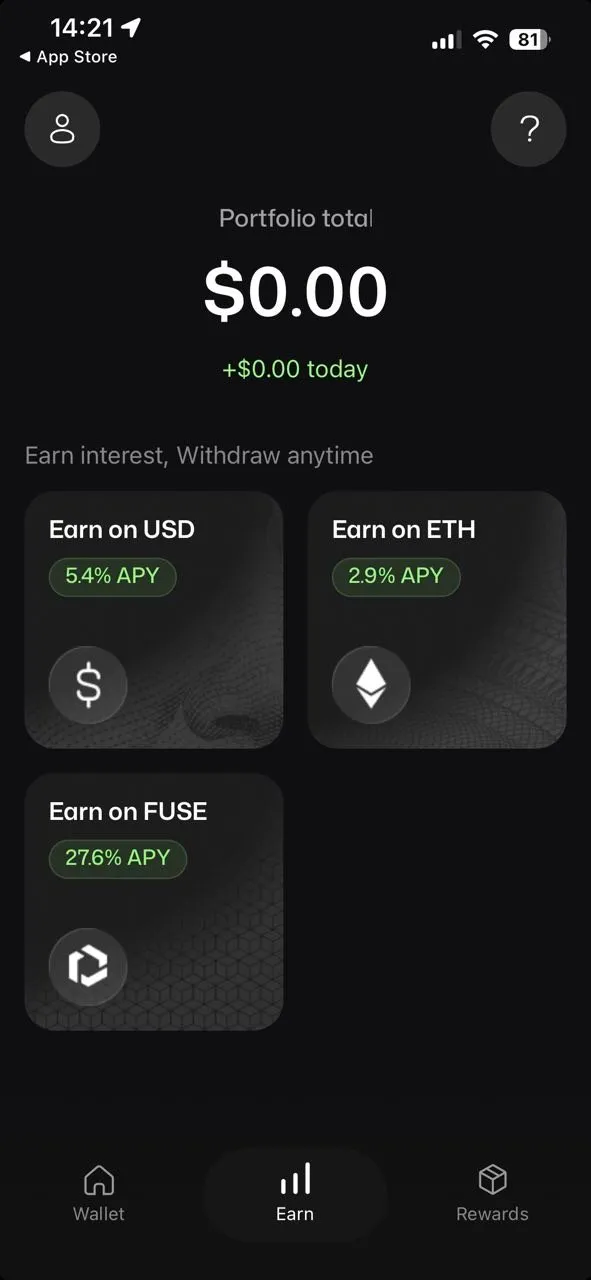
Yield at Solid lives in Savings, where USDC mints soUSD, a vault share run through BoringVaults. The landing page advertises up to 6% on dollars; the app showed 5.4% on USD and 2.9% on ETH on 3 October 2026. Solid keeps 10% of the yield as a fee. Borrow Mode lets the card spend by borrowing USDC against soUSD at a rate Solid does not publish.
FX is 2% on Core, the tier everyone starts on, falling to 1% on Ultra, and cashback is 3% to 5% by tier, across 105 countries including the UK, the EU and 30+ US states. Which balance the card spends is where Solid argues with itself. One help article: “Funds you load onto the card do not earn yield and are held specifically for card spending.” Another describes a “Savings Mode: spend directly from your balance”. We file the card by the first until Solid settles it.
Open Solid CardPartner link.
 14. Tria Card
Sweepbase rating: 3.9 out of 5 · How it earns: Earns in a separate vault · Protocol: Upshift vaults · Custody: Self-custody
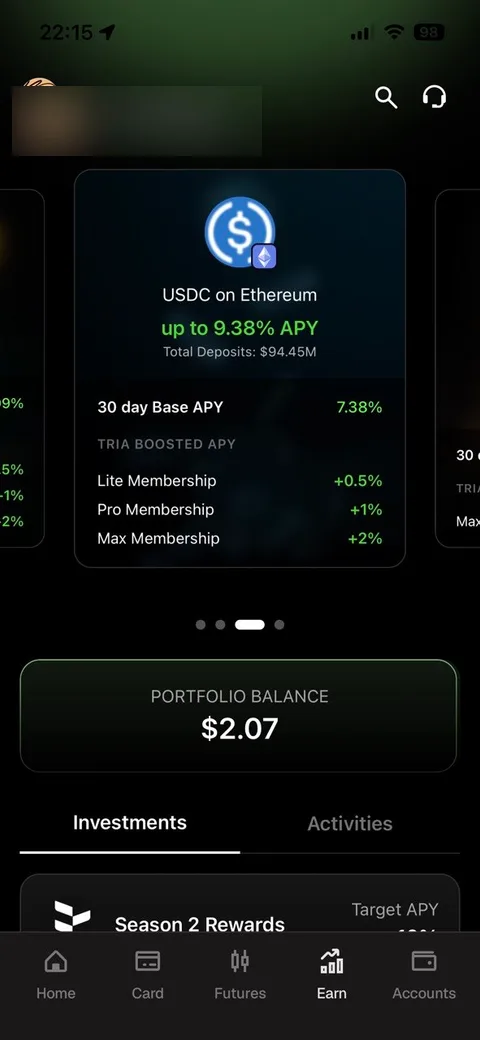
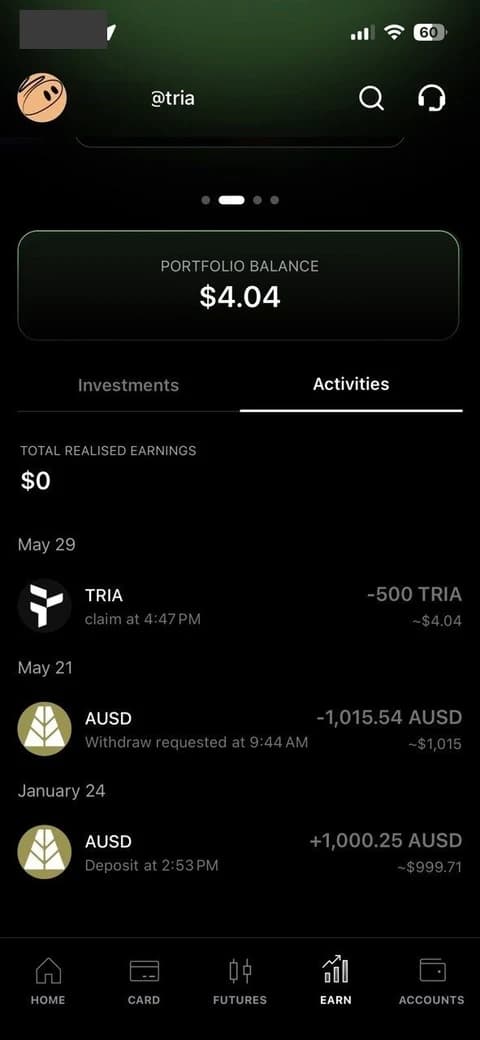
Tria’s card is a 0% APR credit product: crypto collateral backs each dollar charged, and repayment comes from a linked wallet. Yield sits apart, in Earn vaults built on Upshift with strategies from Sentora. On 30 September 2026 the app showed up to 9.38% on USDC on Ethereum and on AUSD on Monad: a 7.38% thirty-day base plus a boost, the full boost only on the paid Max tier. The landing page said “up to 15%” on 27 August and “up to 10%” on 3 October, with no asset attached either time.
Realised returns ran below the tiles. A 117-day AUSD position held from January to May 2026 returned about 4.8% a year. The card terms allow up to $25 for a virtual card, $109 for plastic and $250 for metal, at issue and again yearly, while Tria markets the virtual card as free, so check the price in the app. The Rain exploit of 28 August reached 636 Tria users ($431,945 in card balances), and Tria said it would make them whole in full. Wallet funds were not involved.
Get Tria CardPartner link.
 15. Tuyo Card
Sweepbase rating: 3.9 out of 5 · How it earns: Spends from the earning balance · Protocol: Yield.xyz strategies on Morpho, Aave and others · Custody: Self-custody
Tuyo lets the card spend money that is still in an Earn strategy: “The Tuyo Card can spend your USDC even while it is in an Earn strategy, so it keeps earning until you spend.” The strategies run through Yield.xyz on Morpho, Aave and others, though only Yield.xyz’s own case study names them. Earn-balance spending can be switched off.
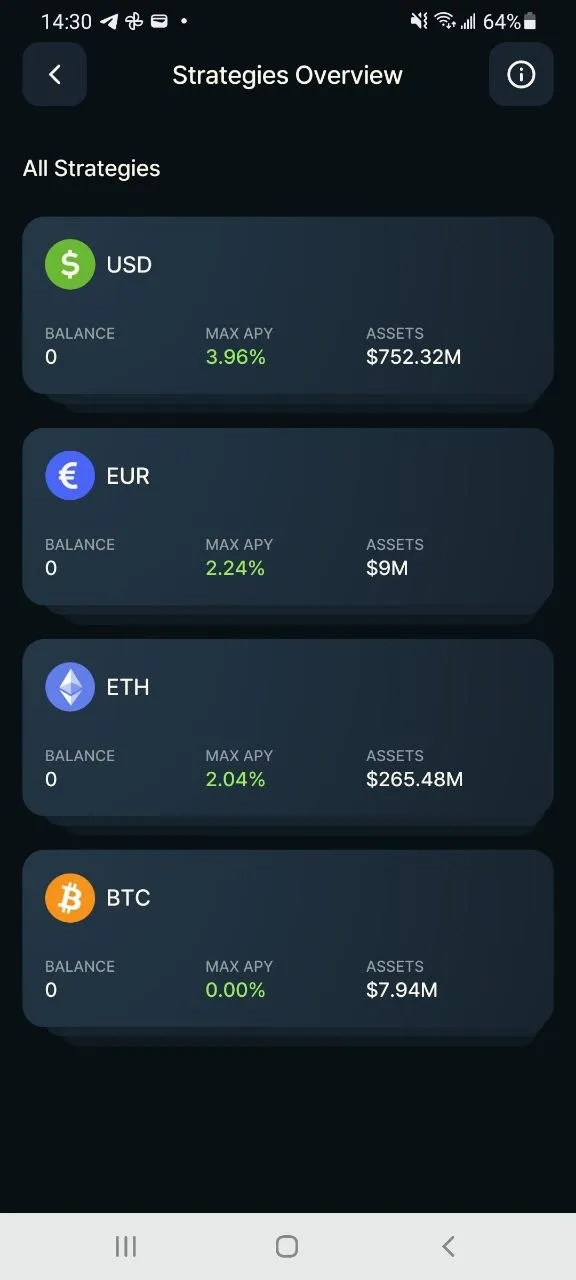
Tuyo’s FAQ still says up to 11% APY after a 10% performance fee. The app is more modest: on 3 October 2026 its strategies topped out at 3.96% on USD, 2.24% on EUR, 2.04% on ETH and 0% on BTC, and Tuyo warns that returns “may be lower or negative”. The pitch is salary in. Bridge gives you USD, EUR or MXN account details, and the money lands as USDC on Base in a wallet you control. A non-USD purchase outside the US costs up to 2%. The UK, India, Israel, Nigeria, Turkey, Ukraine, Vietnam, 19 US states and other listed places are excluded.
Open Tuyo CardPartner link.
 16. Ledger Card
Sweepbase rating: 3.8 out of 5 · How it earns: Earns in a separate vault · Protocol: Lido, and Aave, Morpho and Compound through Kiln · Custody: Hybrid custody
Every crypto-funded purchase on the Ledger card carries a 2% card spend fee, and US cards add $3 for each international online purchase. Cashback is 1%. Baanx runs the card, as a Visa through Cross River Bank in the US and a Mastercard through Monavate in the UK and EEA.
The yield is in Ledger Wallet, apart from the card: liquid staking through Lido, and stablecoin lending that Kiln routes to Aave, Morpho and Compound. Ledger’s own FAQ says crypto moved from the signer to the CL card account is no longer in self-custody, which is why we list the card as hybrid.
Ledger Card sign-upPartner link.
 17. Solayer Card
Sweepbase rating: 3.1 out of 5 · How it earns: Earns in a separate vault · Protocol: sUSD · Custody: Hybrid custody
Solayer charges for its card: a $20 yearly membership, 1.5% plus $0.10 on non-USD purchases (the FAQ on the same site says 1.75%) and $0.15 on every USD purchase. It earns points that cannot be redeemed yet. The excluded list is long: the EEA, UK, Switzerland, Canada, Australia, New Zealand, South Korea, 17 US states and dozens more countries, India, Indonesia, the UAE and Vietnam among them.
The yield is Solayer’s own stablecoin. sUSD is backed by US Treasury bills and pays 4% to 5%, and you switch between it and the USDC spending balance by hand. It passes our rule as a yield-bearing stablecoin, though it is Solayer’s product rather than a third-party protocol. Card payments settle through hot and cold wallets Solayer runs, so we list custody as hybrid.
Get Solayer CardNot a partner link.
 18. Utorg Card
Sweepbase rating: 3.1 out of 5 · How it earns: Earns in a separate vault · Protocol: Morpho · Custody: Hybrid custody
Utorg’s terms name the protocol: “Use the Earn functionality through an in-app connection to the Morpho Protocol.” The card came back after its old provider failed in February 2026, as a USD Visa in place of the EUR Mastercard: virtual, free, Android only, with no cashback and no published FX rate, for the EEA and Ukraine minus Austria, Hungary, the UK and the US. Nothing on it earns. A top-up turns USDC into dollars held by the card provider, Wirex, so the Morpho yield stays in the wallet.
Get Utorg CardNot a partner link.
Morpho and Aave underneath
8 of the 18 cards sit on Morpho, Aave or both. Morpho is under 7 (MetaMask, Tuyo, Deblock, COCA, Hyperbeat, Utorg and Ledger) and Aave under 4 (MetaMask, Tuyo, Plasma One and Ledger). A lot of the card brands are front ends for a vault someone else runs: Veda for MetaMask and Plasma One, Kiln for Ledger, Yield.xyz for Tuyo, Upshift for Tria.
If you hold two of these cards to spread risk, check what sits underneath. Two apps on the same Morpho market are one exposure with two logos. We found the same thing with trading: seven of the nine card apps with a trading desk execute on one order book, as our trading desk guide shows.
Cards you might expect here
Custodial Earn cards such as Nexo or Crypto.com are left out on purpose: the company holds the money, and the yield is what it chooses to pay. Nexo pays on the balance its card spends, so it is ranked in our on-balance yield category. Crypto.com’s Earn sits outside the card balance, so it is in neither list.
Six cards advertise yield without naming the DeFi protocol behind it. Zebec and Avici name a real-world-asset or reinsurance source for part of their yield and no protocol for the rest; Moto, xPortal and Decaf name none; Payy only says its wallet is for earning. They can come back once the issuer says where the money goes, and Decaf also needs its card out of “coming soon” in the app stores. Tangem Pay names Aave, but new Yield Mode activations have been paused since 19 April 2026. MiniPay’s only DeFi route was the Kiln Mini App, which no longer appears on MiniPay’s own Mini Apps page, so it waits until Kiln is back or MiniPay names another protocol. Phantom’s cash yield lives on kamino.com, outside the app. Rebind passes the rule and is held back for now, because it runs on Gnosis Pay’s card programme, which stops on 20 December 2026, and Rebind has not said what replaces it.
Frequently asked questions
7 of the 18: Ether.fi Cash, Exa, MetaMask, Tuyo, Plasma One, Deblock and COCA. On these the card pays from the balance that earns, so nothing has to be moved before each purchase, though several need a one-time deposit into the vault first. Ethena Pay probably works the same way, but its pricing page calls the card a separate product from the USDe yield. Every other card on the list earns in a vault you move money in and out of, or borrows against it.
It is not a bank deposit, and no deposit insurance covers it. Your money sits in smart contracts run by lending protocols. In 2026 Drift froze deposits after an exploit on 1 April, which is why Fuse users now earn through Kamino only. Tangem paused new activations of its Aave-based Yield Mode on 19 April after the Kelp DAO rsETH exploit. On 28 August a Rain card contract was exploited, and Tria reported 636 of its users affected and said it would make them whole. Every rate here is variable, and Tuyo warns in so many words that returns may be lower or negative.
Because the company holds the money, and with custodial Earn you lend to the company rather than to a protocol you can look up. Where those cards are ranked instead is covered in the section above.
Morpho sits under 7 of the 18 cards and Aave under 4, and 8 cards use one or both. The card brand is often a front end for a vault someone else runs (Veda, Kiln, Yield.xyz, Upshift), so holding two of these cards does not spread the protocol risk the way it looks like it should.
Each one is waiting on something the issuer has to fix: Rebind on a replacement for Gnosis Pay’s card programme, MiniPay on its Kiln Mini App reappearing, Tangem on the end of its Yield Mode pause. The section above has the details, along with six cards that do not name their DeFi protocol at all.
Sources & references
This is what we read to write the guide: regulators, issuer fee schedules and archived snapshots. Not every sentence above has its own link here. If a number looks wrong, start with these.
- How to change your spend priority in Direct Pay Mode, ether.fiThe assets Direct Pay can draw on, including the Liquid vault tokens.
- Exa Card, ExactlyIn debit mode each purchase is deducted from the balance.
- MetaMask Money, MetaMaskThe vault lends to markets such as Aave and Morpho.
- Tuyo Card, TuyoThe card spends USDC that is still in an Earn strategy.
- Plasma, Plasma“Keep earning on your balance until you spend.”
- Plasma One and Veda, VedaThe vault provider names the lending markets, Aave among them.
- Deblock 4% current account, DeblockThe Morpho vault, EURCV, and the reserve that smooths the rate.
- COCA 3.0, COCAThe balance earns through Morpho and stays spendable.
- Ethena Pay pricing, Ethena PayBoost caps by tier, the “not interest, not yield” line, and the card as a separate product.
- Xplace yield, XplaceKamino deposits earn and back the credit line at once.
- Tria Earn terms, TriaUpshift provides the vault infrastructure, Sentora the strategies.
- USD+ architecture, HyperbeatDeposits flow through an orchestrator into Morpho markets.
- Bleap crypto card, BleapSavings vault and Lido staking rates.
- Earn yield with Fuse Earn, FuseThe Earn tab and its Kamino and Drift options.
- Solayer Pay overview, SolayerUSDC for spending, sUSD for yield.
- How does my soUSD generate yield?, SolidsoUSD and BoringVaults.
- How to move your card balance back to your wallet or savings, SolidCard funds do not earn yield; the article the guide files the card by.
- What is the Solid Card?, SolidThe Savings Mode line that contradicts it.
- Can I opt out of Account Yield?, DeblockOnce you opt out, you cannot opt back in.
- Jupiter Mobile FAQ, JupiterThe Earn button deposits into Jupiter Lend.
- Utorg terms of use, UtorgEarn connects to the Morpho Protocol.
- Staking with Ledger, LedgerKiln routes stablecoins to Aave, Morpho and Compound.
- Kiln: earn yield on your USDT in MiniPay, MiniPayThe Mini App that connected USDT to Aave, and why MiniPay waits.
- Yield Mode update, TangemThe pause on new Yield Mode activations from 19 April 2026.
- How we test, SweepbaseWhat we verify first-hand and what comes from issuer documentation.