


A weekly email on crypto card fee changes, new cards and cashback cuts.
Best crypto cards in India 2026: three cards that passed a real signup check, and the 30% tax math
Of the 51 live cards whose published coverage reaches Asia, 3 made this list: the ones whose Indian signup we walked ourselves on 17 August 2026, from residency selection through the KYC document screen, ranked by what a rupee of spending costs once FX, funding friction, and the Section 115BBH tax treatment are priced in. Screened September 25, 2026.
We stopped trusting country lists for this guide, including our own citations of them. On 17 August 2026 we re-checked every India claim against issuer sources and then ran the signup flows ourselves with an Indian residential profile. Of our 177-card database, exactly three crypto cards let an Indian resident through onboarding and into KYC with Indian documents: Zypto, UPay, and E Money Network. That is the whole ranking. Everything else either excludes India in its own documents, publishes no verifiable list, or failed the signup check.
Two India-specific facts frame every recommendation. First, no crypto card here accepts rupees: funding runs through stablecoins, so an Indian exchange with UPI deposit becomes part of your cost structure whether you like it or not. Second, every swipe of appreciated crypto is a disposal taxed at a flat 30% under Section 115BBH, with a 1% TDS regime alongside it, and there is no de minimis floor. The cards do not change the law, so the guide prices it in.
The three, in one line each
- Verified signup, lowest commitment: Zypto. Indian KYC accepts Aadhaar, PAN, voter ID or passport; the $10 first load lands on your card balance.
- Cheapest per swipe: UPay. Residence-based onboarding accepts India; fee schedule says 1.0% per transaction and nothing else.
- Only physical card, works at Indian POS: E Money Network. Non-custodial wallet, up to 2% rewards, 3% on overseas swipes.
How we verified India availability
Country lists are wrong in both directions, so the current ranking rests on a harder check. On 17 August 2026 we opened each candidate's signup flow with an Indian residential profile and walked it as far as the flow allows without submitting real identity documents. For Zypto that meant reaching the Sumsub verification step and reading its India document menu: passport, Aadhaar card, PAN card, or voter card, four Indian document types configured deliberately.
For UPay it was a KYC dropdown labelled Country of Residence that accepts India and proceeds to a document-upload screen. For E Money Network it was a Sumsub profile form that accepts an Indian residential address and Indian-issued passports and ID cards.
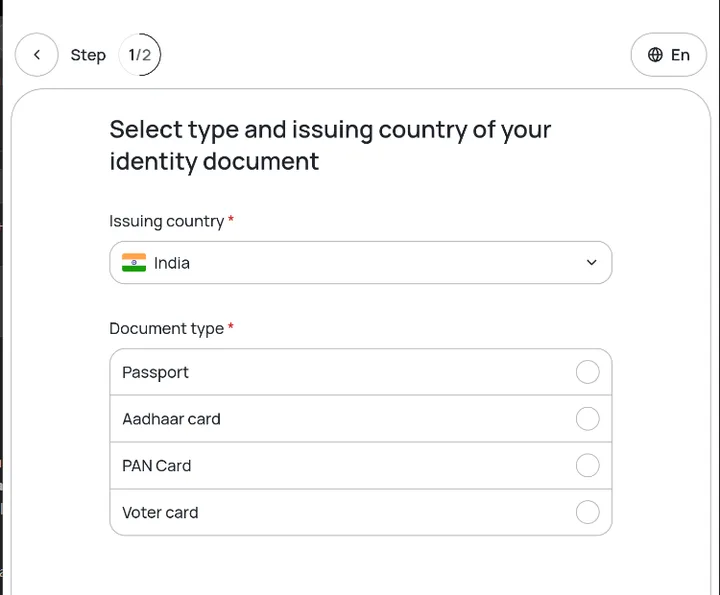
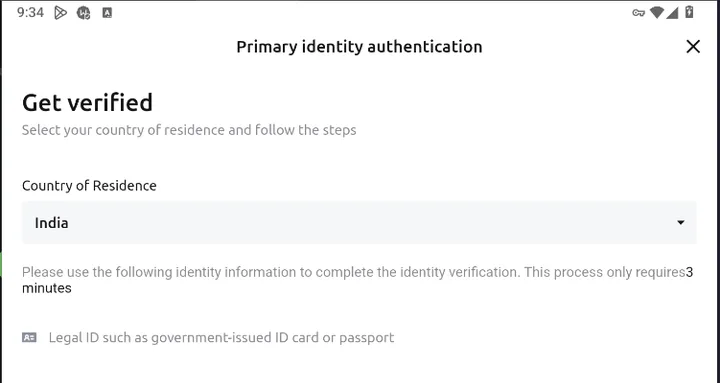
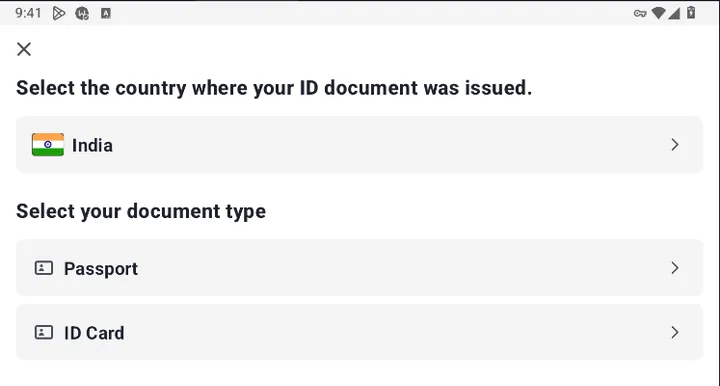
That evidence has two limits. We did not submit real Indian documents, so final KYC approval is the one step we have not seen. The flows were walked to the last screen before it. A walked signup also says nothing about how often Indian POS terminals decline foreign prepaid cards. That one stays open. Everything else here is first-hand and dated, and you can repeat it.
What this revision removed, and why
The previous version of this guide ranked five cards on the strength of issuer country lists, and readers correctly challenged it. Re-verification against issuer sources removed three of the five. Spritz names India in its country checker, but selecting India shows a cross on every product and a waitlist button, so a list mention meant nothing. Fizen's own documentation carries an unsupported-countries table with India in it. KAST no longer publishes a country list anywhere public.
KAST's help centre says the signup dropdown is the only source of truth, and the last cached copy of its restricted list named India. Kolo survives only as an honorable mention below, because its evidence is terms that fail to exclude India rather than a verified signup. The Avalanche Card, previously an honorable mention here, states outright that it cannot issue to residents of India, and is gone. We keep this section in the guide because a ranking that quietly rewrites itself is worse than one that shows its corrections.
Zypto first, on the strongest India evidence
Zypto Card, 4.0/5 in our database, is the one to try first. It carries the strongest India evidence we hold on any product: a signup walked to the KYC document screen with Aadhaar, PAN, voter ID, and passport all accepted. The product an Indian profile is offered is a virtual Mastercard, up to three cards per account, and the $10 minimum first load is credited to the card balance, so getting a working card number costs nothing beyond money you were going to spend anyway.
Two cards in the wider India set did not make the ranking: Plasma One (4.6/5) scores higher, but its signup was invite-gated when we checked and its India case rests on unverified terms, and Xapo Bank (3.6/5) charges $1,000 a year, which typical Indian spending volumes never earn back. Both sit in the honorable mentions.
| Rank | Card | Best for | Rating | India evidence | Network |
|---|---|---|---|---|---|
| #1 | Zypto Card | Verified signup, free virtual card | 4.0/5 | Signup walked to KYC; Indian documents listed | Mastercard (virtual) |
| #2 | UPay Card | Cheapest per swipe | 3.4/5 | Residence dropdown accepts India | Visa |
| #3 | Emoney Card | Only physical card of the three | 3.7/5 | Indian address and documents accepted | Mastercard (physical) |
| Unranked | Wise Card | Fiat travel companion | 2.9/5 | Issuer's own India help article | Visa/Mastercard |
A card ranks only if we walked its signup
Base scores come from the Sweepbase database (177 cards, 25 data points). For India the gate is behaviour, not documents: a card ranks only if we walked its signup with an Indian residential profile on 17 August 2026 and the flow accepted Indian residency and presented a KYC path for Indian documents. Issuer country lists alone stopped qualifying, because we caught them failing in both directions: naming India while blocking every product (Spritz), and not naming India while a dedicated India page exists (UPay's own countries-served hub).
Two weights decide the order within the ranking. One is funding friction, because every card here is crypto-funded and an Indian user starts from rupees. The other is fee honesty on non-USD spending, because these are foreign-denominated cards and every rupee swipe crosses that boundary. Rewards paid in points are counted below cash. Nothing in this ranking is paid placement, and the rating formula does not read affiliate status.
The 3 crypto cards that passed
#1. Zypto Card: verified signup, free virtual Mastercard (4.0/5)
| Network | Mastercard virtual for India signups; Visa Signature on Premium tiers we were not offered |
|---|---|
| Issuance fee | $10 minimum first load, credited to the card balance |
| Annual fee | None on the virtual card |
| Cashback | ZYP reward points (1,000 ZYP = $1) |
| FX fee | 1.75% + $0.30 per transaction |
| Custody | Custodial once loaded |
| Top-up | 100+ cryptocurrencies |
| India KYC | Sumsub, accepts passport, Aadhaar, PAN, or voter card |
Zypto is #1 on evidence, not on fee schedule. We selected India at onboarding, passed into verification, and read the document menu ourselves: four Indian document types. Somebody configured India in that KYC on purpose; it is not merely absent from a blocklist. The card an Indian profile is offered is the virtual Mastercard, up to three per account, with a $10 minimum first load that lands on the card balance.
Zypto's own pages disagree about the Premium tier: the help centre lists India for its Premium Visa cards, while the legal restricted-countries page (last updated 1 May 2026) names India among the countries where the virtual and physical Premium Visa are unavailable to residents. The app sided with the legal page: the signup we walked offered only the virtual Mastercard, a product Zypto's documentation does not describe, so treat the Premium tier as unavailable for India and the virtual card as verified by the walk, not by the docs.
The per-swipe economics are the ranking's worst: 1.75% FX plus a flat $0.30 punishes small payments in percentage terms.
Pros:
- Strongest India evidence in this guide: signup walked to the KYC document screen
- Indian documents accepted: Aadhaar, PAN, voter ID, or passport
- Effectively free: the $10 minimum load is credited to your balance
Cons:
- 1.75% FX plus $0.30 flat per transaction adds up fast on small swipes
- Virtual only for India signups; the Premium Visa tiers were not offered
- Custodial once funds are loaded; rewards in ZYP points, not cash
Open Zypto CardPartner link.
#2. UPay Card: cheapest per swipe (3.4/5)
| Network | Visa, virtual and physical (Premier Card) |
|---|---|
| Issuance fee | $10 sign-up; 10 USDT virtual, 100 USDT physical (support fee table) |
| Annual fee | Free |
| Cashback | None advertised |
| FX fee | India page: 0% international, 1% per transaction; support fee table: 2% recharge fee at load and no per-transaction row. UPay has not reconciled the two |
| Custody | Custodial |
| Top-up | Major cryptocurrencies and stablecoins |
| India KYC | Country of Residence dropdown accepts India; generic document list |
UPay maintains a dedicated India page on its own site, and the signup backs the marketing up: the KYC dropdown is labelled Country of Residence, which is the right question to ask, and India proceeds to document upload. The economics are simple but not free: a $10 sign-up fee, 10 USDT for the virtual card and 100 USDT for the physical one, no annual fee, no cashback to weigh, and one load-bearing fee that UPay's own pages state two different ways.
The India page says 1% per transaction with 0% on international spending; the support-centre fee table shows a 2% recharge fee at load and no per-transaction row at all. Until they reconcile it we price the swipe at 1% and the load at 2%, which is still the cheapest path here. One line in UPay's restricted-countries list (1 April 2026) matters for this guide: Indian nationals cannot apply for the Platinum card, while the Premier card carries no such restriction, so apply for Premier.
The document list is generic (national ID, passport, driving licence, residence permit) rather than India-tuned like Zypto's, so expect the standard foreign-issuer experience with Indian paperwork.
Pros:
- Cheapest verified option per swipe: 1% per transaction on the India page, no annual fee
- Residence-based onboarding accepts India; dedicated India page on the issuer's site
- Physical Premier Card exists, and high published limits ($200,000 daily)
Cons:
- UPay's own pages disagree on the load-bearing fee: 1% per swipe on the India page, 2% at load in the support fee table
- Not free to start: $10 sign-up plus 10 USDT (virtual) or 100 USDT (physical); Platinum card closed to Indian nationals
- No cashback at all
- Custodial; document list is generic rather than India-specific
UPay Card sign-upNot a partner link.
#3. Emoney Card: the only physical card of the three (3.7/5)
| Network | Mastercard, physical only |
|---|---|
| Issuance fee | $99 one-time, paid in USDT or USDC before the card ships; no per-transaction fee |
| Annual fee | $0 |
| Cashback | Up to 2% in points: 1 point per $1, claimable in BTC, EMYC and others (the 2% figure comes from the issuer's January 2025 announcement; its fee docs do not state a rate) |
| FX fee | 3% on overseas swipes (1% E Money + 2% mandatory Mastercard); every INR swipe is "overseas" to this card |
| Custody | Non-custodial smart-contract wallet; collateral custody undisclosed |
| Top-up | USDT (Ethereum), USDC (Ethereum, Solana, Base), BSC-USD (BNB Chain) via the E Money Network app |
| India KYC | Sumsub accepts Indian address and Indian passport or ID card |
E Money Network, the rebranded Scallop project, earns its slot on two facts. The signup accepts an Indian residential address and Indian-issued documents, which we checked ourselves. And it ships the only physical card of the three, which in India matters more than anywhere else: with no Apple Pay in the country, plastic is the only way any of these cards works at a domestic counter.
The price of that plastic is the worst FX in the ranking: 3% on every swipe outside Hong Kong, because the card treats INR as overseas spending by construction. The up-to-2% rewards claw some of that back if you actually claim the points. Its docs phrase eligibility by citizenship and warn that residency requirements may apply, so the walked signup is doing real work here.
Pros:
- The only physical card of the three: works at Indian POS terminals
- Non-custodial smart-contract wallet holds your spendable funds
- Up to 2% rewards, $0 annual fee, no per-transaction fee
Cons:
- $99 up front before any card ships, and the issuing bank is named nowhere
- 3% FX on every INR swipe is the worst rate in this ranking
- Collateral custody is not disclosed, an odd gap for a self-custody pitch
- Docs phrase eligibility by citizenship, with a residency caveat they do not specify
Open Emoney CardNot a partner link.
Wise, the fiat special case (2.9/5)
Wise is not a crypto card: it never touches a wallet, and we list it in our database as the fiat companion crypto-card holders keep for cheap FX. It is in this guide because its India availability is the best-documented of any card here: Wise's own help centre states the Travel Card is available to Indian residents, with KYC through Aadhaar number, PAN, and video verification. Two product limits define it.
The card cannot be used for transactions within India (or Nepal and Bhutan): it is a travel card for spending abroad, loaded from rupees, with a monthly spending cap of 70,000 US dollars for cards issued in India. And it holds fiat, so nothing about the Section 115BBH analysis in this guide applies to it.
If your problem is "my Indian bank card charges brutal forex markups when I travel", this is the boring, well-regulated answer, and pairing it with one crypto card from the ranking covers both halves of the use case.
Every rupee swipe pays foreign-currency fees
These are foreign-denominated cards, so every rupee purchase is a foreign-currency transaction to them. The FX column below is the price of using the card at home, not a travel footnote.
| Card | Issuance | Annual | FX on INR swipes | Funding route |
|---|---|---|---|---|
| Zypto | $10 load, credited to balance | Free | 1.75% + $0.30/transaction | 100+ coins |
| UPay | $10 sign-up; 10 USDT virtual / 100 USDT physical | Free | 1% per transaction (India page); support fee table shows 2% at load instead | Major coins and stablecoins |
| Emoney | $99 one-time | $0 | 3% (1% + 2% Mastercard) | Crypto via app |
| Wise | Card fee applies | Free | Not usable inside India; 0.33-3.5% mid-market when abroad | INR via Indian rails |
| Card | Value |
|---|---|
| UPay (India page, per swipe) (1.0%) | 100% |
| UPay (support fee table, at load) (2% recharge) | 200% |
| Zypto (1.75% + $0.30) | 201% |
| Emoney (3%) | 300% |
Rupee cost of a single ₹10,000 purchase at each card's published rate, taking ₹87 per US dollar for Zypto's flat 30-cent surcharge. UPay appears twice because its own pages disagree: the India page charges 1% per transaction, the support-centre fee table shows a 2% recharge fee at load and no per-transaction fee. Crypto-to-fiat conversion spreads at load time are separate and apply to all crypto-funded cards. Wise is absent because it cannot be used for domestic Indian transactions at all.
The bill on ₹25,000 a month
Take ₹25,000 a month of card spending, about $287 at ₹87 to the dollar, spread over fifteen transactions. On UPay you pay ₹250 at the India page's 1% per swipe, ₹500 if the support fee table's 2% at load is what applies, and earn nothing back. That is the cheapest of the three at the India page rate. On Zypto the 1.75% costs ₹437, and then the flat $0.30 lands fifteen times: another ₹390 or so, which nearly doubles the bill. Flat fees punish Indian ticket sizes. Zypto's fee list also carries a ~3% off-ramp fee that its pages do not tie to a specific step; if it applies to your load, add about ₹750.
On E Money Network the 3% FX costs ₹750, and the up-to-2% rewards claw back as much as ₹500 of it if you claim the points. That nets out near UPay once the $99 card fee is paid, with plastic at the counter as the real payoff. At typical personal volumes, then, the fees land within a few hundred rupees of each other. Pick on evidence, custody and form factor rather than on headline rates.
Taxed and tolerated, with no card framework
India neither bans crypto nor licenses it coherently. The banking blockade ended in March 2020 when the Supreme Court struck down the RBI's 2018 circular in IAMAI v. RBI; since then exchanges operate with bank access and register with FIU-IND under the anti-money-laundering framework. The 2022 Budget then built a tax regime for virtual digital assets, which settled the "is this allowed" question in the most bureaucratic way possible: the state taxes it, therefore you may hold it.
What does not exist is any framework for crypto cards. The RBI has issued no licence category these products could apply for, and no crypto card in this guide is issued by an RBI-regulated entity: all three reach Indian users as foreign-issued Visa and Mastercard products. Two consequences follow. Consumer protection is whatever the issuer's home jurisdiction provides, from Gibraltar banking law (Xapo, in the honorable mentions) down to terms-of-service promises.
And India's exchange-control rules under FEMA were written long before stablecoin cards existed and do not address them; how a foreign-funded spending instrument fits those rules is a question we have not seen answered with any authority. It belongs in your accountant's inbox, not on a marketing page.
The enforcement that does exist targets platforms, not cards, and it reaches cards anyway. On 1 October 2025 FIU-IND served non-compliance notices under the anti-money-laundering law on 25 offshore crypto platforms, with takedown notices for their apps and URLs until they register as reporting entities. Four of the 25 have a card row in our catalogue: CoinW and BingX, both live; Zoomex, whose card closed to new applicants in July 2026; and YouHodler, whose card has been announced but not issued to anyone.
None of the four names India for its card (CoinW publishes no country list at all), so nothing on this page changes; the point is that an app ordered offline cannot onboard an Indian resident onto anything, whatever the issuer's list says. Registration works in the other direction too, and slowly: Bybit registered in January 2025, returned to the Indian app stores on 8 September 2025, and told Moneycontrol an Indian card is "still sometime away".
The four separate walls behind all this, each read from its own document, are in our research on why crypto cards do not work in India.
Flat 30% under Section 115BBH, plus 1% TDS
The rules are short and harsh. Income from transferring a virtual digital asset is taxed at a flat 30% under Section 115BBH, plus applicable surcharge and cess. The only deduction allowed is the cost of acquisition; losses from one VDA cannot offset gains from another, or anything else, or carry forward. Spending crypto on goods or services counts as a transfer, and there is no de minimis exemption: the law taxes a coffee the same way it taxes a car.
Alongside it runs the 1% TDS regime, Section 194S of the 1961 Act, carried into the new Income Tax Act as Section 393. Indian exchanges deduct it on trades automatically. Foreign card issuers do not, which shifts the reporting burden to you. And the subtle trap for stablecoin spenders: gains are measured in rupees, so USDT bought at ₹83 to the dollar and spent at ₹87 produced a taxable gain from currency movement alone.
Keep acquisition records for every load; at 30% with no offsets, documentation is the only lever you control.
No Apple Pay, no UPI link, rupees in through an exchange
Apple Pay does not exist in India (as of 25 September 2026). The cards here advertise Apple Pay or Google Pay support (E Money Network lists Apple Pay as coming soon), and none of it helps you at an Indian counter: Apple Pay had not launched in India by September 2026, though press reports from that month expect an October launch that starts with Axis Bank credit cards, and the Indian Google Wallet release handles passes, not card payments (the Google Pay app is a UPI client). Until that changes, in-store tap in India means the physical card.
That downgrades every virtual-only product to an online-and-travel tool, and it cuts right through this ranking: Zypto's India offering is virtual by construction, which is why physical-only E Money Network ranks despite the worst FX rate on the page.
UPI does not connect to any of these cards. No foreign card links to UPI, and the street merchants who take only QR codes will never take these cards. Domestically they work at organised-retail POS and international-friendly online checkouts. The realistic use case for an Indian resident is spending crypto on international services, travel, and the online purchases where a dollar-denominated card beats the forex markup Indian bank cards commonly add on foreign-currency spending.
The funding path is part of the price. Rupees enter crypto through an FIU-registered exchange (UPI deposit, buy USDT, withdraw on-chain), and each leg has a cost: exchange fees, the TDS mechanics, a network fee. A card with a low headline fee but an expensive funding path can cost more end-to-end than a pricier card fed cheaply. Price the whole route before committing to any of the three.
No-KYC options exist but price themselves. SolCard (2.4/5) does not exclude India from its published list and advertises a $5,000/month no-KYC cap, at the price of a 5% top-up fee plus a one-time $10 issuance fee, so roughly $50 per $1,000 loaded (checked August 29, 2026). We have not walked its signup, so it sits in the unverified tier. Our no-KYC guide covers which of these claims hold up.
Plasma One, Xapo, and the unverified tier
Plasma One (4.6/5) is the highest-rated card in the whole India set and it is not in the ranking for two reasons: signup was invite-gated when we checked, and its India case rests on terms that exclude only US persons and sanctioned countries, which is absence-of-exclusion evidence, not a verified signup. The card is free, keeps USDT in self-custody on the Plasma chain until the moment you pay, and pays 2% cashback on the free tier's first $500 a month.
If the gate lifts and an Indian signup verifies, it goes straight to the top of this page. Xapo Bank (3.6/5) is the licensed-bank option: a Gibraltar bank with depositor protection, IBAN and SWIFT rails, 0% FX, and 4.10% variable on USD savings held apart from the card. Its general BTC cashback ended on 30 June 2026. Its India evidence is its own announcement of accepting members across South Asia including India. The $1,000-a-year membership decides it: the card makes sense for a serious balance looking for a banking home and for nobody else.
The unverified tier. A further set of cards publishes exclusion lists that do not name India, while publishing no positive India confirmation we could verify and no signup we have walked: Kolo (3.9/5, terms exclude only sanctioned jurisdictions), plus Oobit and others in our database. Cryptomus sits one step lower still: it publishes no country list at all. Tria belongs here for a different reason: its card terms carry no list of eligible or excluded countries, gating only on US citizenship, sanctions, and your own confirmation that local law permits the product.
A review that lists India among the countries Tria excludes is not quoting Tria, because no Tria document names India either way. PlasBit is the cleanest absence in the set: India is in none of its three prohibition lists as of 5 September 2026 and it keeps a marketing page addressed to India, but we have not walked its signup and know of no Indian resident who has. RedotPay (3.6/5) left this tier on 28 August 2026, when its Card Issuance Restrictions article added India: residents are ineligible for both virtual and physical cards, so it is now excluded.
A card that does not block India has not confirmed India. Bybit's card was in exactly this tier until its application flow gained a modal reading "Bybit Card Unavailable for India Residents", and in its first interview after re-entering India in September 2025 the exchange described an Indian card as a product it is "looking into" with the RBI and FIU, "still sometime away". If you hold one of these as an Indian resident, that single data point outweighs every list, and our corrections inbox is open.
Documents, funding and records
- Pick the card from the table above based on where your crypto sits, and check its detail page for the current fee schedule.
- Pass KYC with the documents each issuer accepts. Zypto's flow lists passport, Aadhaar, PAN, and voter card for India; E Money Network takes an Indian passport or ID card; UPay asks for a national ID, passport, driving licence, or residence permit. We verified the document menus, not final approval, so expect variance on the last step.
- Fund it with stablecoins. The standard route is an FIU-registered exchange: INR in via UPI, buy USDT/USDC, withdraw on-chain to the card's wallet or deposit address.
- Record the acquisition cost in INR for every load and the disposal value of every swipe. Section 115BBH allows no other deduction, and no issuer here files Indian TDS for you.
- Order the physical card if offered. With no Apple Pay in India as of 25 September 2026, plastic is the only way these cards work at a domestic counter. Of the three, only E Money Network ships one today.
Top crypto cards for India
Zypto CardVerified signup (4.0/5): Indian KYC documents accepted, $10 first load credited to balanceUPay CardCheapest per swipe (3.4/5): 1% per transaction, residence-based onboarding accepts IndiaEmoney CardOnly physical card (3.7/5): non-custodial wallet, up to 2% rewards, 3% FXWise CardFiat travel companion (2.9/5): Indian residents via Aadhaar/PAN KYC, abroad-only spending
Frequently asked questions
We screened the 143 live cards in our database and then walked the Indian signup flows ourselves. Zypto Card ranks first (4.0/5 Sweepbase rating): we ran its signup with an Indian residential profile on 17 August 2026, and the KYC flow accepts Aadhaar, PAN, voter ID, or a passport. The product offered is a virtual Mastercard whose $10 minimum first load is credited to the card balance, so issuance is effectively free. Only two other crypto cards passed the same check, UPay and E Money Network, and they are the rest of the ranking.
There is no ban. The Supreme Court struck down the RBI circular that cut exchanges off from banking in March 2020 (IAMAI v. RBI), and since 2022 the government taxes virtual digital assets explicitly, which presupposes you may hold and dispose of them. What India does not have is any licensing framework for crypto cards: none of the three crypto cards in this guide is issued by an RBI-regulated entity, and all of them reach Indian users as foreign-issued Visa or Mastercard products. That leaves consumer protection thinner than for a domestic card, and the exchange-control questions under FEMA are genuinely unsettled. A chartered accountant is the right person to map your exposure.
Spending crypto on goods or services is a disposal of a virtual digital asset, and gains are taxed at a flat 30% under Section 115BBH (plus applicable surcharge and cess), with no deduction except acquisition cost and no offsetting of losses. The 1% TDS regime (Section 194S of the 1961 Act, renumbered Section 393 in the new Income Tax Act) applies to VDA transfers. On Indian exchanges the platform deducts TDS for you; what a card issuer settling abroad does about TDS is not something any of the three publishes, so the reporting burden effectively sits with you.
Very likely yes, and the reason is the rupee, not the dollar. Gains are computed in INR: if you bought USDT at ₹83 per dollar and spend it when the rupee sits at ₹87, the depreciation alone created a rupee-denominated gain, taxable at 30% on disposal. A stablecoin pegged to the dollar is not pegged to the rupee. The amounts per swipe are small, but Section 115BBH has no de minimis floor.
Not the crypto cards. None of the three picks accepts INR: every one is funded with crypto, usually stablecoins. The practical path for an Indian user is an FIU-registered exchange: deposit INR via UPI or IMPS, buy USDT or USDC, withdraw on-chain to the card or its wallet, and account for the exchange fee, the 1% TDS mechanics, and the network fee on withdrawal. That friction is real and it is part of the true cost of every card in this guide. Wise, the fiat special case at the bottom of the ranking, is funded from rupees, which is why it is not a crypto card.
RedotPay is the crypto card Indian forums ask about most, and since 28 August 2026 the answer sits on its own help centre: the Card Issuance Restrictions article now lists India among the areas whose residents are ineligible for both virtual and physical cards. Until that update the article was an exclusion list that did not name India, which is why an earlier version of this guide kept RedotPay in the unverified tier rather than the ranking. The update settles it: RedotPay is excluded, not unverified.
No. Apple Pay had not launched in India by September 2026, so the Apple Pay support these cards advertise only matters when you travel. Press reports from September 2026 expect a launch in October, starting with Axis Bank credit cards; until it ships, and until a foreign crypto card is actually accepted in it, nothing changes. Google Wallet exists in India but its Indian release centres on passes and tickets, not card tap-to-pay; the Google Pay app Indians use daily is a UPI client and cannot hold a foreign Visa. In-store payments in India therefore need the physical card. That is a real limitation for the virtual-only picks: a virtual card from India is an online and travel instrument, not a checkout-counter one.
No. UPI is a domestic rail tied to Indian bank accounts and RuPay credit lines; a foreign-issued Visa or Mastercard cannot be linked to it. At the many small merchants who accept only UPI QR, a crypto card is no help. Where these cards work domestically is the organised-retail POS network and online checkouts that accept international cards. For an Indian resident, a crypto card complements UPI for international and online spending. It does not replace it.
Of the three in the ranking, E Money Network comes closest: the card runs on a non-custodial smart-contract wallet, though how the collateral behind the card is held is not disclosed. Zypto and UPay are custodial once loaded. The clean self-custody option for India sits in our honorable mentions: Plasma One keeps USDT in a wallet you control until the moment of purchase, but its signup was invite-gated when we checked and its India availability rests on terms that simply do not exclude India, which is weaker evidence than a walked signup.
DICGC deposit insurance covers Indian bank deposits up to ₹5 lakh and none of these products falls inside it. Zypto and UPay are custodial, so whatever the company holds for you joins the insolvency estate in a foreign jurisdiction. E Money Network holds spendable funds in a smart-contract wallet you control, which helps, with the caveat that its collateral custody is undisclosed. Xapo, in honorable mentions, is the opposite kind of special case: a fully licensed Gibraltar bank with its own depositor-protection regime, which is part of what the $1,000 membership is buying.
The 1% TDS applies to transfers of virtual digital assets, and on Indian exchanges the platform handles deduction on trades. Buying USDT with INR is the seller-side event; when you later swap, sell, or spend that USDT, the transfer provisions reach you. P2P and international routes shift the compliance burden onto the individual rather than removing it. Keep records of every leg: acquisition cost in INR is the only deduction Section 115BBH allows.
Sources & references
This is what we read to write the guide: regulators, issuer fee schedules and archived snapshots. Not every sentence above has its own link here. If a number looks wrong, start with these.
- Supported Countries for Premium Physical & Virtual Cards, Zypto Help CenterZypto's help-centre country list naming India under South Asia; our signup walk found the virtual Mastercard offered to Indian profiles rather than these Premium tiers.
- Reloadable Virtual and Physical Zypto Visa Card: Restricted Countries and States, ZyptoThe legal page (last updated 1 May 2026) that lists India among the countries where the Premium Visa is unavailable to residents, contradicting the help-centre list above and matching what the app showed us.
- Countries Served: India, UPayUPay's dedicated India page: 1% per transaction, zero international fees, $10 sign-up; the issuer's site moved from upay.best to upay.com.
- Restricted and Prohibited Countries, UPay SupportUPay's restricted list (1 April 2026): Indian nationals may not apply for the Platinum card; the Premier card list does not name India.
- Card Issuance Restrictions, RedotPay Help CenterUpdated 28 August 2026 to add India: residents are ineligible for both virtual and physical cards. The April 2026 version of the same article did not name India.
- Which countries' citizens are eligible to apply for an E Money Card, E Money NetworkIndia in the eligible list, phrased by citizenship with an unspecified residency caveat; our signup walk confirmed Indian addresses and documents are accepted.
- Wise Travel Card in India, WiseAvailability for Indian residents, Aadhaar/PAN/video KYC, and the rule that the card cannot be used within India, Nepal, or Bhutan; the 70,000 USD monthly spending cap for India-issued cards is in Wise's separate card-limits article.
- FIU IND issues notices for non-compliance to 25 offshore VDA SPs under Section 13 of the PML Act, Financial Intelligence Unit, India (full-text mirror)The 1 October 2025 release: PMLA notices plus app and URL takedown notices to 25 offshore platforms, four of which (YouHodler, CoinW, Zoomex, BingX) have card programmes in our database (YouHodler's announced but not yet issued, Zoomex's closed to new applicants since July 2026); 50 providers registered to date.
- Crypto exchange Bybit steps up India push with team expansion, user growth drive, crypto card plans, MoneycontrolBybit's first interview after its September 2025 re-entry: an Indian card is a product it is looking into with the RBI and FIU, 'still sometime away'.
- International Card Terms & Important Disclosures, TriaLast updated 9 January 2026: no country list, no mention of India; eligibility rests on non-US citizenship, sanctions screening and the cardholder's own confirmation that local law permits the product.
- List of Prohibited Countries, PlasBitIndia absent from this list and from the prepaid-card and no-delivery lists on 5 September 2026; an absence, not a confirmation.
- Taxation on Cryptocurrency: Guide to Crypto Taxes in India, ClearTaxSection 115BBH flat 30% treatment, no loss offsets, and the list of taxable events that includes spending crypto on goods or services.
- TDS under Section 194S of the Income Tax Act, ClearTaxThe 1% TDS regime on VDA transfers, carried into the new Income Tax Act as Section 393.
- Supreme Court's judgment on virtual currencies (IAMAI v. RBI), AZB & PartnersAnalysis of the 4 March 2020 judgment that struck down the RBI banking circular and re-opened bank rails for Indian crypto businesses.
- FIU-IND registered virtual digital asset service providers, Financial Intelligence Unit, IndiaThe AML registration regime that Indian exchanges (the practical INR on-ramp for every card here) operate under.
- Visa Foreign Exchange Rate Calculator, VisaThe daily wholesale INR rate on top of which each card's published FX margin applies.