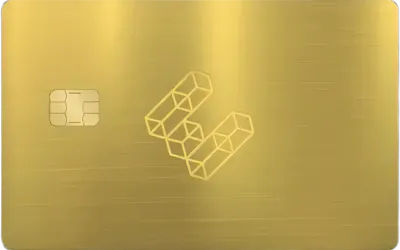
Hyperbeat Card Review 2026
Last reviewed · against issuer documentation
How this rating is calculated · Algorithmic score, not user reviews
Independently reviewed by Mihail B. · how we verify
Get Hyperbeat CardPartner link. We may earn a commission, which never affects the rating or where this card ranks.
Card Overview
Most cards that call themselves self-custodial ask you to take the word on faith. Hyperbeat writes down what it cannot do: it "cannot move, lock, freeze, or change your wallet", the collateral behind the credit line sits in Morpho smart contracts rather than on a company balance sheet, and the help centre tells you how to export the key into MetaMask or Rabby if the app disappears tomorrow. Sign-in is a passkey, so there is no seed phrase to lose. The card on top is a Visa Signature issued by Third National, and it runs in two modes that behave very differently at the till. Cash Mode debits your USD balance and costs nothing extra. Credit Mode borrows stablecoins against collateral you keep — BTC, ETH, SOL, HYPE, tokenised gold or the USD+ vault — so you spend without selling, but interest starts the moment you swipe, compounds continuously, and a bad market can liquidate you at a 12.68% bonus to whoever closes the position. Three numbers deserve a second read. Cashback is a deposit ladder rather than a spend rate: 0.25% until you hold a thousand dollars, 0.55% above ten thousand, doubled at most by boosters for spending, trading and saving, so 1.1% is the ceiling — and it pays in WHYPE, whose price you then carry. The FX rate is published twice at different numbers: the help centre says 0.4% to 1%, while the cardholder agreement schedules up to 3% foreign exchange plus up to 3% cross-border. Those are ceilings rather than a competing quote, so they need not contradict the marketed rate — but nothing published says how the real charge is worked out, and nobody has reported a settled figure. And the yield does not touch the money the card spends; it lives in a separate USD+ vault whose advertised rate depends on where you read it — 3% to 8% in the help centre, typically 5% to 8% in the docs, up to 8% on the homepage, with no realised figure published anywhere. You can pledge it back as collateral, but the card never debits it. There is no physical card yet, so no ATM access despite a published ATM fee schedule.
Best fit: someone already holding assets on Hyperliquid who wants to spend against them without selling and cares more about controlling the keys than about the headline rate. Wrong card if you want cashback that tracks your spending, a plastic card, a rate you can predict before the purchase settles, or a US cardholder agreement you can read before signing up.
This is a Visa crypto card. It uses a self-custody model. It offers cashback rewards. Available to US residents. Available in Europe.
Fees & Limits
| Issuance Fee | Free — "You can issue up to 20 virtual cards for free". Physical card price not disclosed |
|---|---|
| Annual Fee | None disclosed — the published consumer rates-and-fees page lists no annual or monthly fee |
| FX Fee | 0.4%-1% on top of the Visa scheme rate. The issuer states it twice — "Foreign exchange rate fees: 0.4%-1%" on the consumer fee page and "Purchases with a Hyperbeat Pay card have a 0.4%-1% FX rate" in its FX article — and support repeats it. The Cardholder Agreement's "Foreign Exchange Fee (non USD): up to 3%" plus "Cross Border Fee: up to 3%" is the Third National/Rain issuing template rather than this programme's price: the identical schedule, down to the $40 late-payment, $29 returned-payment and $35 liquidation penalties, appears verbatim in the Cypher and Solayer card terms on the same rails. Read those as ceilings, not quotes. Note the base: 0.4-1% sits on top of Visa's own rate, not interbank, so the true cost over interbank is Visa's spread plus this margin. No settled real-world figure has been reported by anyone (checked 2026-08-01). |
| ATM Limit | $1 + 0.65% per withdrawal, $0.60 balance inquiry, $0.60 declined attempt. Blocked outright in FATF-blacklisted countries (North Korea, Iran, Myanmar). Requires the physical card, which the same help centre still lists as coming soon |
| Spending Limit | $100,000 default monthly limit, "not currently configurable by user"; the terms let Hyperbeat raise, cut, or zero it at any time without notice |
These figures can change. Confirm the current fees, FX and network in Hyperbeat’s official terms before you apply.
Features
- Welcome Bonus: $5 referral
- Card Type: Virtual only. The help centre card-order flow lists "Physical card" and nothing physical ships yet, while the ATM fee schedule on the same site already assumes one exists. Up to 20 virtual cards per account, though the consumer fee schedule on the same site says "5 virtual card limit"
- Top up with: Native BTC, ETH and SOL from an external wallet or exchange, credited as Unit assets; USD via ACH and EUR via a virtual bank account opened in the holder’s own name through Noah; in-app swaps and trading
- Available Countries: Global bar the published blocklist. Prohibited: Belarus, China (Mainland), Cuba, India, Iran, Iraq, Israel, Myanmar, Nepal, Nicaragua, North Korea, Russia, Syria, Turkey, Ukraine, Venezuela, Vietnam, plus 16 US states (Arizona, Delaware, Georgia, Idaho, Louisiana, Maryland, Nevada, New Mexico, North Dakota, Ohio, Oregon, Rhode Island, South Dakota, Vermont, Washington). Wisconsin appears on both the supported and the prohibited list — the issuer contradicts itself. Both lists are the issuing platform's rather than this programme's: the same 17 countries and the same 16 states appear verbatim and in the same order in Xplace's published terms, another Third National card on the same Rain rail. Vietnam, Turkey, India and Nicaragua are barred here yet served by the same issuer's virtual bank accounts, Vietnam with a dedicated local-currency deposit rail (checked 2026-08-08)
Banking & Fiat Rails
Yes — a virtual bank account in the holder’s own name for USD (ACH, banking services through Lead Bank) and EUR, and third parties can pay into the IBAN. SWIFT not documented
Who issues the Hyperbeat Card
The Hyperbeat Card has a different issuer depending on where you sign up. Each one is listed below with its own source.
The Hyperbeat Card is issued by Third National (Nimbus LLC), USA — Puerto Rico money transmitter (NMLS #2612780); a subsidiary of Signify Holdings, Inc. ("Rain") per Rain's privacy policy. The issuer is named in the source linked below. "The Hyperbeat Card is issued by Third National pursuant to a license from Visa"; the card-terms document adds a Nigeria clause naming BANEX Microfinance Bank as the local marketer.
Primary source · All cards issued by Third National (Nimbus LLC) · Why the issuer matters
The Hyperbeat Card is issued by BANEX Microfinance Bank Limited, Nigeria (CBN-licensed microfinance bank) — Local marketer of record, not the issuing bank. The issuer is named in the source linked below. — clause 7.4 "Nigerian Users": the card "is marketed to you by BANEX MICROFINANCE BANK LIMITED", which also files the requisite returns with the CBN. The issuer stays Third National.
Primary source · All cards issued by BANEX Microfinance Bank Limited · Why the issuer matters
Supported Cryptocurrencies
You can load the Hyperbeat Card with crypto; the 2 assets we track for it are listed below. When you pay, the card converts crypto to local fiat automatically.
Networks & deposit details: Native Bitcoin, Ethereum mainnet and Solana mainnet deposits, credited as Unit assets on Hyperliquid; confirmations run 2+ blocks on Bitcoin, 14 on Ethereum, 32 on Solana. Accepted collateral: wHYPE and beHYPE at 45% LTV, UBTC at 50%, UETH and USOL at 45%, XAUT gold at 40%, USD+ at 75%. Withdrawals do not return to the native chain
Who Is the Hyperbeat Card Best For?
The Hyperbeat Card is a good fit for DeFi users and privacy-focused holders who want to keep their own keys until they actually spend.
The Hyperbeat Card pays 0.25% cashback on eligible purchases, so it works well as a daily spending card.
The card is currently available in Published supported list: Antigua & Barbuda, Argentina, Australia, Bahamas, Bangladesh, Barbados, Belize, Bolivia, Brazil, Cayman Islands, Colombia, Costa Rica, Côte d’Ivoire, Dominican Republic, Ecuador, Egypt, El Salvador, Europe, Ghana, Grenada, Guatemala, Guyana, Honduras, Hong Kong, Japan, Kenya, Malaysia, Mexico, Morocco, New Zealand, Nigeria, Pakistan, Panama, Paraguay, Peru, Philippines, Saint Kitts and Nevis, Saint Lucia, Saint Vincent and the Grenadines, Senegal, Singapore, South Africa, Suriname, Thailand, Trinidad and Tobago, Turks & Caicos, Uganda, United Arab Emirates, Uruguay, Zambia, plus 35 named US states including New York, so it works for residents and travellers in those areas.
Best for
- Frequent spenders who want to earn 0.25% cashback
- DeFi users who want to hold their own keys
- US residents who want a crypto spending card
Avoid if
Compare the Hyperbeat Card side-by-side with alternatives using the full card listing or explore our Visa crypto cards category.
Pros & Cons
Pros
- Self-custody stated as a mechanism, not an adjective — collateral sits in Morpho contracts and the wallet exports to MetaMask or Rabby if Hyperbeat disappears; Visa Signature perks including lounge access via Visa Airport Companion; virtual cards are free and issue instantly; native BTC, ETH and SOL top-ups with no wrapper step; Cash Mode and Credit Mode switch per transaction; iOS and Android apps shipped July 2026
- Earn 0.25% cashback on eligible purchases
- No card issuance fee
- Works wherever Visa is accepted worldwide
- Self-custody: you keep your private keys until you spend
- Available in most countries
Cons
- Cashback is set by how much you deposit rather than how much you spend, tops out at 1.1%, and pays in WHYPE, a token whose price you then carry; the two published FX figures differ by a factor of six; no physical card yet, so no ATM access despite a published ATM fee schedule; Credit Mode is a continuously compounding variable-rate borrow with liquidation risk at a 12.68% bonus to liquidators; the spendable balance earns nothing unless moved into USD+; the public Cardholder Agreement is the non-US one and requires you attest you are not a US citizen, while the country list names 35 US states
- Annual fee: None disclosed — the published consumer rates-and-fees page lists no annual or monthly fee
- Full KYC required, no anonymous tier
How to Get the Hyperbeat Card
Here is what the sign-up process looks like, from application to first purchase.
Create your Hyperbeat account
A few minutesGo to the Hyperbeat website or download the app.
Complete identity verification
Varies by issuerHyperbeat runs standard KYC: a government-issued photo ID and usually a selfie. Processing time varies by issuer and load.
Fund your card
Usually instantLoad your card with Native BTC, ETH and SOL from an external wallet or exchange, credited as Unit assets; USD via ACH and EUR via a virtual bank account opened in the holder’s own name through Noah; in-app swaps and trading through the funding screen.
Start spending immediately
InstantYour virtual Hyperbeat Card shows up in the Hyperbeat app right away. Use it online or add it to Apple Pay / Google Pay for tap-to-pay in stores.
Requirements
Regional Availability
Available Worldwide
The Hyperbeat Card is available in most countries. Some places may be excluded because of local financial regulations, so check the Hyperbeat website to confirm before you apply.
Common questions about the Hyperbeat Card
What are the fees for the Hyperbeat Card?
Is the Hyperbeat Card legit, and who is behind it?
Is the Hyperbeat Card worth it?
How does the Hyperbeat Card cashback work?
Where is the Hyperbeat Card available?
What cryptocurrencies does the Hyperbeat Card support?
Similar Cards Worth Comparing