


A weekly email on crypto card fee changes, new cards and cashback cuts.
How to tell a crypto card's real site from a wallet-drainer clone
A privacy card called OffGrid has a second website. It looks like the first one, promises more than the first one, and near the end of its sign-up flow it asks you to connect a wallet and approve a "payment layer." The real OffGrid never does that. The company said so itself, in public, months before we looked. We use OffGrid here because the copy is unusually clean and the trap is unusually clear, but the point is the five checks below. Each would have caught this clone in about a minute and will catch the next one on a different domain.
The five checks, one line each:
- Does the site match the link in the product's own bio, not just a search result?
- Why would a card ever need you to connect a wallet?
- Is there a crypto "activation fee" charged before the card even exists?
- Does a deliberately wrong password still log you in?
- Are the promises richer than what the real product publishes about itself?
The two sites
The genuine product lives at app.offgrid.cash (the bare offgrid.cash redirects there). It is an invite-only, no-KYC virtual card funded with crypto. To get in you need a code in the format OG-XXXX, which the project hands out free in replies under its own posts. The claim page shows a card, three lines of copy, and one button.

The lookalike lives at offgridcash.com. It copies the genuine landing page closely, then changes the parts that matter. In August, where the original landing page said "Up to $4,000/month," the copy said "Up to $20,000/month." It adds a "$10 Bonus on your first Visa card" and an "Apple Pay & Google Pay Ready" badge the real product cannot honor, because OffGrid does not support Apple Pay. It drops the code, too. No invite needed, and the card is issued on the spot.
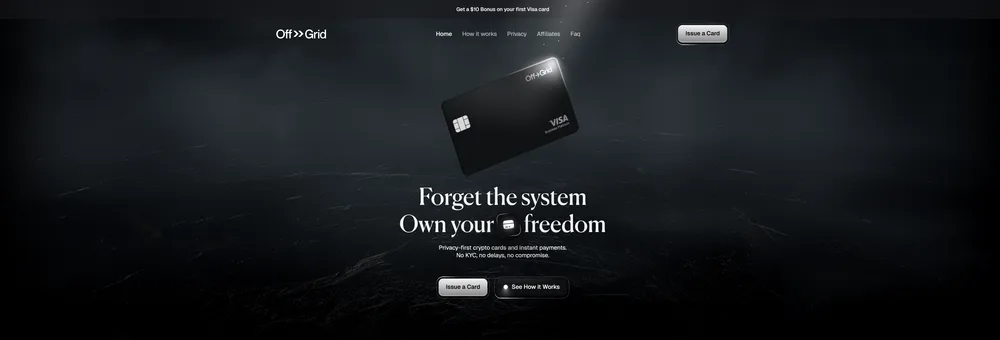
The copy is close enough that it left fingerprints. The clone's fonts are the same files as the real site's build, down to a trial version of a paid typeface. Its privacy policy still says "when you use our website offgrid.cash." The footer of the original reads "© 2025 Off Grid LLC"; the copy dropped the "LLC." Whoever built it saved someone else's page and edited the visible text.
The company said it isn't theirs
You do not have to take our word for which site is real. On 17 May 2026 the OffGrid account posted, in full:
Fake OffGrid sites are circulating. One site to remember: app.offgrid.cash. That's it. Nothing else is us. We will never ask you to connect your wallet. Our product is invite only.
Three months later, on 17 August 2026, a user replied to the account asking "This one is a scam? https://offgridcash.com". The account answered: "Yes. Our only site is https://offgrid.cash" (that address redirects to app.offgrid.cash/claim).
The disavowal came late in the domain's life. The registry record (RDAP) shows offgridcash.com registered on 8 December 2025 through NiceNIC, on Cloudflare nameservers; the name had carried an unrelated off-grid-living blog back in 2018, was dropped, and was picked up again. The Wayback Machine has the clone live by 31 January 2026. ScamSniffer put it on its public blocklist on 15 April 2026 (commit c848825, which also files the entry under a list dated 8 April 2026). The company's reply came four months after that. One more detail cuts the other way: the clone's own front-end code links to x.com/offgridcash and t.me/offgridcash as the brand's social accounts, while the genuine app.offgrid.cash does not link to that X account anywhere. The copy vouches for the account that later disowned it.
A note on that exchange: the word "scam" was the user's, not the company's. What the company confirmed, answering a direct question, was that the domain is not theirs. The stronger statement is the one they wrote in May, unprompted: we will never ask you to connect your wallet. That sentence, from the company itself, is the test the rest of this piece just applies.
Five checks that catch a clone in a minute
None of these needs a wallet, a developer, or a single transaction. Run them before you type anything.
1. Match the domain to the product's own social profile, not to search. Search results and ads are bought; the link in the product's own bio is not. OffGrid's bio links to offgrid.cash, and only that. If the site in front of you is not the site the project links to itself, stop.
2. Ask why a card would want your wallet. A card needs a deposit address, which means you send to it. Connecting a wallet and signing an approval is the opposite direction. A prepaid card has no reason to ask for spend permission on your tokens. If it does, the "card" is not the product.
3. Treat a crypto "activation fee" as a red flag by itself. Real issuers take their fee out of the balance you load. They do not ask you to sign a transaction before the card exists. A one-time $2 activation fee that you pay by connecting your wallet is the hook, not a fee.
4. Log in with a wrong password on purpose. If a made-up email and any password let you in, the site has no backend. On the clone, the login form runs no network call at all: it waits two seconds and forwards you to a dashboard. A site that cannot tell a real account from a fake one is not running accounts.
5. Compare the promises to what the real product publishes. A clone is almost always more generous than the thing it copies, because it has no costs to cover. Higher limits, a bonus that appeared from nowhere, a payment method the original doesn't offer: each gap is a copy that was "improved" to close the sale.
The clone can outrank the real site
When we searched Google for "offgrid card" on 25 August 2026, the top result was the clone, sitting above the genuine app.offgrid.cash and above the project's own X account. We ran it twice, from a US-English search and a Russian-language one. Same order both times.
We checked again on 28 August 2026, eleven days after the company disowned the domain, and Google still put the clone first with the genuine site second. Other engines do not agree: on the same day Bing and DuckDuckGo kept the clone out of their top ten entirely, and Brave placed it fifth. So this is a Google result, not a law of search. It is also the engine most people will use, which is the whole problem.
Checked a third time on 30 August 2026, thirteen days after the disavowal, with personalisation switched off (pws=0): the clone first, app.offgrid.cash second, no sponsored results on the page. DuckDuckGo still had it out of the top ten and Brave still had it fifth.
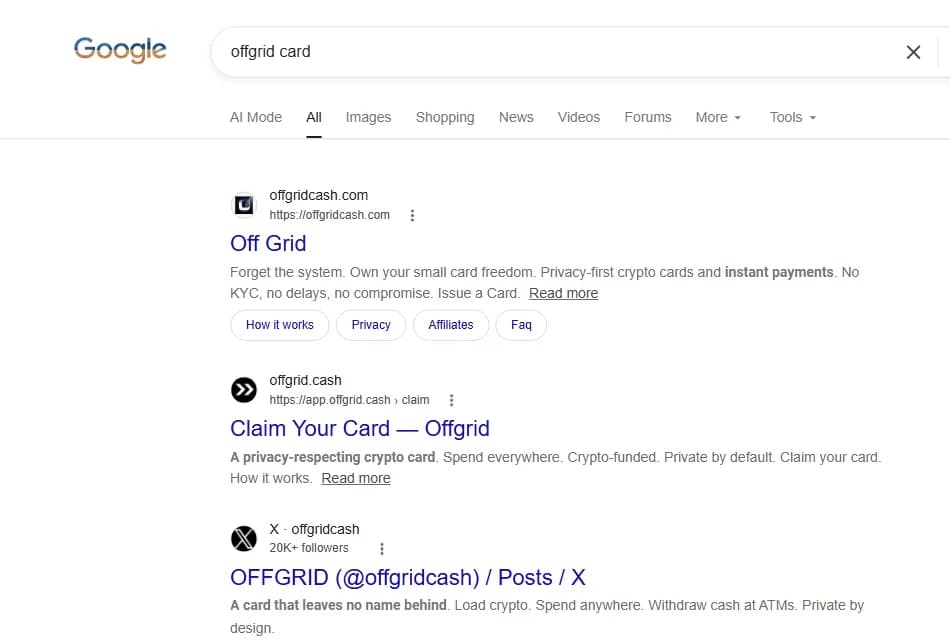
A top ranking is not a safety check. These were the ordinary results, not ads: search rewards pages that are built to be found, and a clone whose whole site is a public marketing page can be built for exactly that. The real OffGrid barely exists for a search engine, an invite-gated app with almost nothing to crawl. On its own brand name, it lost the top spot to the copy. This is why the first check sends you to the link in the product's own profile, not to the first thing a search returns.
What the clone does
Reading the funnel screen by screen shows why those checks land. You do not need to understand the code to see the shape of it, only to notice that a card is never issued this way.
The dashboard is where a clone stops looking like a card. On offgridcash.com, it opens without any login and walks you through "Get Your Virtual Crypto Card in 2 Minutes," gated behind a one-time $2 fee. The steps are numbered: Link Your Wallet → Approve Our Payment Layer → Set Your Card Limits.
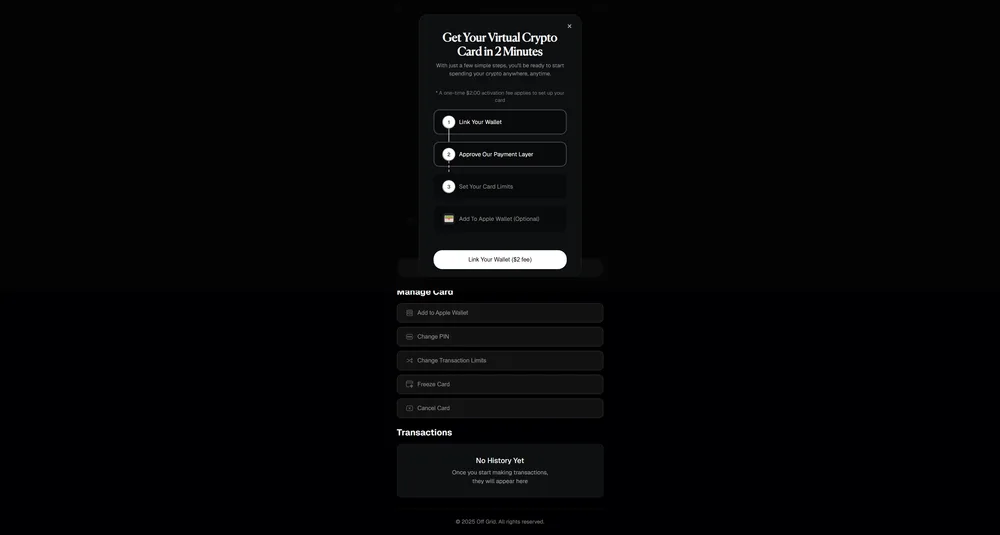
"Approve Our Payment Layer" is the line to read twice. In an EVM wallet, an approval grants another address permission to move your tokens. Check Point Research, documenting this exact family of scams, describes the mechanism plainly: the approve method "grants permission to another address to spend a certain amount of tokens," and the theft then runs as two transactions. You approve, and afterward the attacker calls transferFrom and pulls the balance. The $2 is there so the wallet approval looks like a routine setup step. The approval is the part that costs you.
Everything around that screen fits the same reading. The wallet connector is set to work across dozens of chains at once, and a card that only ever needs one network does not shop across dozens. The page loads a full transaction library, a fingerprinting script that tags your device, and a call that records your IP before reporting to a remote endpoint. The connect-wallet button is hidden and clicks itself half a second after the page loads. A card gets issued without any of this. What you are looking at is the opening move of a drainer, which wants standing permission over the wallet rather than a single payment.
On 30 August 2026 we listed what the dashboard pulls in, by name. On arrival, before any click: a 263 KB main.js wrapped in Function("...") obfuscation, which we have not unpacked; a 2.5 MB bundle.js that is Reown's AppKit wallet connector (the dashboard even shows a "powered by Reown" logo under the button); fpbundle.js, which is FingerprintJS 4.6.2; and modals.js, a popup kit rendered in a shadow DOM whose error screen reads "Something went wrong! Please try a different wallet." The AppKit bundle phones Reown's API with a project ID, 8ae938963e559bebea09b02aeec915c6, and that project is live: Reown's wallet-list endpoint answers it and refuses a made-up one. That ID is a lever a takedown can pull; a wallet connector with a revoked project stops connecting wallets. The page's own visible loader, a script called configgg/main.js, points at a path the server answers with the site's homepage HTML, so the real loading is done by the obfuscated file. Only after the wallet buttons are clicked does the page fire the conversion beacon and fetch the wallet list.
One more thing sits in that page, and it is the tell we did not expect. The dashboard carries a Meta advertising pixel, and the function that opens the wallet modal fires a named conversion event the moment the modal appears: fbq('track', 'AddToCart'). Re-checked on 28 August, it is still there, on the landing page and inside the dashboard both; on 30 August we watched the beacon leave for facebook.com/tr with ev=AddToCart in a clean browser, no wallet involved. That is not a visitor counter. It is the plumbing an advertiser uses to measure which spend produced which wallet connection, so whoever runs this is treating the approval step as the goal of a campaign and paying to optimize toward it. You can confirm it yourself without a wallet: fetch the dashboard with no cookies and read the source.
There is one limit we hold to. We did not connect a wallet, so we did not watch money leave. The "drainer" label here rests on behavior: the auto-connect, the approval step dressed as a fee, the multi-chain reach, the obfuscated code and the reporting endpoint. We think that behavior is enough to keep your wallet in your pocket, but it is not a court finding.
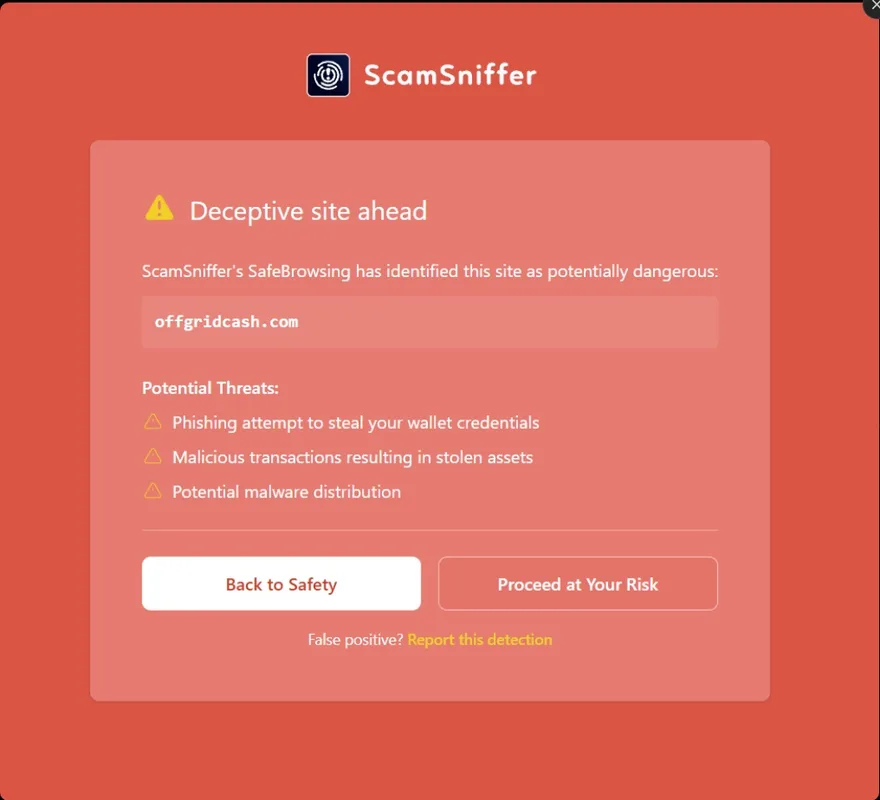
We are not the only ones reading it this way. ScamSniffer, an independent wallet-security tool, lists offgridcash.com in its public blocklist. Anyone who visits with its extension installed gets a "Deceptive site ahead" page that flags a phishing attempt on wallet credentials and transactions ending in stolen assets. That is a separate party, on its own signals, landing where we did. A blocklist is a heuristic, not a court ruling. But when a dedicated anti-scam tool and a plain read of the funnel agree, keeping your wallet closed is the easy call.
If you already connected a wallet there
Move quickly, in this order.
- Cancel the permissions you granted. Open a tool like revoke.cash, connect the wallet, and cancel every approval you do not recognize. Do it on each network the site touched, not only the one you started on. An approval stays live until you cancel it.
- Move your money to a new wallet. Create a fresh wallet on a device you trust, and send anything valuable to it before the approval can be used.
- If you ever typed your recovery phrase (the 12 or 24 words) into that site, the wallet is compromised for good. Canceling approvals will not help, because the keys themselves are exposed. Move everything out and stop using it.
- Have the less obvious permissions checked too (Permit2 allowances, account delegations). These can leave standing access even after a plain approval is cancelled, so have someone who knows the tools take a second look.
A note on the real card, so this isn't mistaken for an endorsement
This piece says the clone is dangerous. It does not say the genuine OffGrid is safe to fund. Those are different claims, and only the first one is settled.
The real product discloses very little about who stands behind it. Its terms name the card issuer only as "a licensed card issuing partner," never a company; there is no legal entity, no ascertainable jurisdiction, and no governing-law clause in the document. The site footer does carry a copyright line, "© 2025 Off Grid LLC," but the terms themselves name no entity. Its own terms also say money loaded onto the card "cannot be withdrawn and must be spent," and that a closed account's card balance "will be forfeited." Independent evidence that the card works in the wild is thin. Whether the real OffGrid deserves your money is a question this article does not try to settle. The fake one is easier to judge. Do not connect a wallet to it.
How we checked this, and what we can't claim
- The first round of checks was run on 25 August 2026. The clone's pages were opened in an isolated browser window; no wallet was connected, no form submitted, no invite code used.
- The "drainer" label is based on observed behavior, not on a theft we recorded. The malicious transaction only forms after a wallet connects, which we did not do.
- In the disavowal exchange, "scam" is the questioner's word. The company confirmed the domain is not theirs; it did not itself publish the word.
- Both domains hide their owners behind private registration. We have not tied the clone to any named person or company. The clone's registration date (8 December 2025), registrar and nameservers come from the public RDAP record; its first live capture (31 January 2026) from the Wayback Machine; the blocklist date from ScamSniffer's git history.
- Re-checked on 30 August 2026: the domain, the dashboard, the pixel and the wallet stack were all still live. The script inventory above comes from a clean browser session with no wallet extension; the obfuscated
main.jswas not deobfuscated, so we still cannot say what the approval would sign, and we have not identified the drainer kit behind the popup code. - Re-checked on 25 September 2026 with a plain page fetch, no browser and no wallet: the clone's dashboard still served the "Approve Our Payment Layer" step and the
AddToCartpixel call, andoffgrid.cashstill redirected to app.offgrid.cash/claim. We did not repeat the search-ranking check that day. - The genuine
offgrid.cashdomain was registered 7 July 2025 per the registry record; a 2024 date that appears in some scanners did not check out. - The Google ranking was captured on 25 August 2026 from two setups (a US-English search and a Russian-language one). Search results are personalized and change constantly, so treat that screenshot as a dated snapshot, not a fixed state.
- Clones move. If the funnel described here is gone by the time you read this, the tells have not changed. Run the five checks on whatever site is in front of you.
Sources & references
This is what we read to write the guide: regulators, issuer fee schedules and archived snapshots. Not every sentence above has its own link here. If a number looks wrong, start with these.
- OffGrid disavowal: "Fake OffGrid sites are circulating", OffGrid (@offgridcash)The project's 2026-05-17 post naming app.offgrid.cash as its only site and stating it will never ask you to connect your wallet.
- OffGrid confirms the lookalike domain is not theirs, OffGrid (@offgridcash)The 2026-08-17 reply answering "Yes. Our only site is https://offgrid.cash" to a question about the clone domain; that address redirects to app.offgrid.cash/claim.
- Wallet Scam: A Case Study in Crypto Drainer Tactics, Check Point ResearchPrimary write-up of the approve / transferFrom drainer mechanism the clone funnel reproduces.
- ScamSniffer blocklist: offgridcash.com flagged as deceptive, ScamSnifferIndependent Web3 anti-scam tool; its public domain blocklist includes offgridcash.com, and its extension shows a "Deceptive site ahead" phishing warning on visit.
- ScamSniffer commit c848825: the day offgridcash.com entered the blocklist, ScamSniffer (GitHub)Committed 2026-04-15 02:08 UTC; the parent commit does not contain the domain. The same commit files it under blacklist/archive/2026-04-08.json.
- RDAP record for offgridcash.com, Verisign RDAPRegistration event 2025-12-08, registrar NiceNIC International Group, Cloudflare nameservers. No registrant identity is exposed.
- Wayback Machine capture index for offgridcash.com, Internet ArchiveA 2018 capture of an unrelated blog on the same name, a 2023 redirect, then the clone from 2026-01-31 onward.
- Revoke.cash: review and cancel token approvals, Revoke.cashTool for cancelling standing token approvals across networks if you connected a wallet to a suspicious site.
Frequently asked questions
The people behind OffGrid were asked that on X and answered that the domain is not theirs (their only site is app.offgrid.cash). "Scam" was the questioner's word, not the company's. What the lookalike site does, though, is unambiguous: near the end of its sign-up it asks you to connect a wallet and approve a "payment layer," which is how a wallet drainer works. We did not connect a wallet, so we did not watch money leave, but the behavior is enough reason not to touch it.
A drainer is a site or app that gets you to sign a blockchain transaction that hands it standing permission over your tokens. In an EVM wallet the key step is an "approval," which grants another address the right to move a token on your behalf. Once you approve, the attacker calls transferFrom and pulls the balance. A prepaid card never needs that permission, so a "card" site that asks for it is not a card.
Run five checks before you type anything. Match the site to the link in the product's own social profile, not to a search result. Ask why a card would ever need you to connect a wallet. Treat a crypto "activation fee" you pay by signing a transaction as a red flag by itself. Log in with a deliberately wrong password and see if it lets you in anyway. And compare the promises to what the real product publishes, because a clone is almost always more generous than the thing it copies.
Move fast, in order. Open a tool like revoke.cash, connect the wallet, and cancel every approval you do not recognize, on each network the site touched. Move anything valuable to a fresh wallet created on a device you trust. If you ever typed your recovery phrase into the site, the wallet is compromised for good: canceling approvals will not help because the keys themselves are exposed, so migrate everything out. Then have the less obvious permissions (Permit2 allowances, account delegations) checked by someone who knows the tools.
A top ranking is not a safety signal. Search rewards pages that are built to be found, and a clone whose whole site is a public marketing page can be built for exactly that. The real OffGrid is an invite-gated app with almost nothing for a search engine to crawl, so on its own brand name it lost the top spot to the copy in every Google check we ran between 25 and 30 August 2026. Use the link in the product's own profile, not the first result a search returns.
This guide does not settle that. It says the clone is dangerous, which is a separate claim. The genuine product discloses very little about who stands behind it: its terms name the issuer only as "a licensed card issuing partner," with no legal entity or governing-law clause, and its own terms say loaded funds cannot be withdrawn and a closed account's balance is forfeited. Whether the real card deserves your money is a question we do not try to answer here.